
English
Static members and namespaces
Static members
A static member (the static modifier) belongs to the class, not to an individual object (https://learn.microsoft.com/dotnet/csharp/programming-guide/classes-and-structs/static-classes-and-static-class-members):
- a static field exists as a single instance for the whole class, regardless of the number of objects (Fig. 8.7). It is used for counters of created objects, number generators, and shared settings;
- a static method is called through the class name (
Math.Sqrt(2),int.Parse(text)); it has no access tothisor instance fields because it is not associated with any object (accessing an instance member causes error CS0120); - a static property provides access to static data:
DateTime.Now,Order.CreatedCount.
Figure 8.7. A static field and instance fields
A method that uses no object data should be made static: this shows that it does not change state. Visual Studio suggests this option (Fig. 8.8).
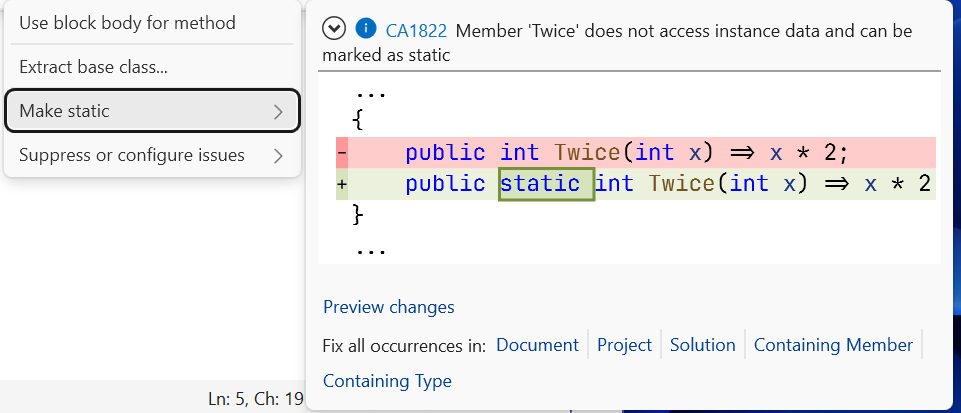
Figure 8.8. Suggestion to make a method static
Static constructor
A static constructor (static ClassName() { … }) initializes static fields. It has no access modifiers or parameters, is called automatically once before the first object is created or a static member is first accessed, and cannot be called explicitly (https://learn.microsoft.com/dotnet/csharp/programming-guide/classes-and-structs/static-constructors). The order is: static field initializers first, then the body of the static constructor, and only then the regular constructor of the first object. If a static constructor throws an exception, the class becomes unusable for the rest of the program’s run, so complex logic in it is avoided.
Static classes and using static
A static class (static class) contains only static members; you cannot create an object of it. Sets of helper functions that are not tied to state are organized this way: Math, Console, Convert, and your own validation and conversion classes. The using static directive lets you call static members without the class name:
cs
using static System.Math;

Console.WriteLine(Sqrt(Pow(3, 2) + Pow(4, 2)));   // 5
Console.WriteLine(Round(PI, 3));                  // 3,142
Static classes are convenient, but you should not use them for data that changes: global mutable state (static fields modified by different parts of the program) makes code harder to understand and test.
Factory methods and private constructors
If an object can be created in several ways from parameters of the same types (a temperature in °C, °F, or K is always a double), constructor overloading is impossible. In that case, the constructor is made private, and objects are created by static factory methods with clear names: Temperature.FromCelsius(36.6), TimeSpan.FromMinutes(90). A factory method can also return an existing object or report failure without an exception, following the TryCreate or TryParse pattern. An example of such a class is given in the lab assignment.
Namespaces and project organization
A namespace (namespace) groups related types and prevents naming conflicts. By convention, the namespace matches the project name and folder structure: a class in the file Bank.Core/Models/Account.cs has the namespace Bank.Core.Models. Types from another namespace are imported with a using directive or referenced by their fully qualified name.
Recommendations for organizing code:
- one public type per file with the same name;
- domain classes go in a class library, input and output in the application;
- use
internalfor helper types that are not part of the library’s contract.
The partial modifier lets you split the declaration of one class across several files (partial class Report). It is used mostly for code partly generated by tools (form designers, code generators), not to “hide” an overly large class; such a class is better split into several classes.