
English
SOLID and dependency injection
Design quality
A program that works is not necessarily well designed. Good code is easy to read, change, and test. There are two main design characteristics:
- cohesion is how closely the members of a class are related by a common purpose; high cohesion means that a class does one thing;
- coupling is how much classes depend on each other; loose coupling lets you change one class without affecting others.
The goal of design is high cohesion and loose coupling. Signs of poor design (“code smells,” Topic 18) include a class of thousands of lines that “can do everything,” long switch statements on the type of an object, repeated code, and a change to one requirement that affects many classes.
General principles:
- DRY (Don’t Repeat Yourself): every piece of knowledge should have a single representation in the code;
- KISS (Keep It Simple): the simplest solution that works is the best;
- YAGNI (You Aren’t Gonna Need It): do not implement features “just in case.”
The SOLID principles
SOLID is a set of five object-oriented design principles formulated by Robert Martin (Table 17.1).
Table 17.1. The SOLID principles
| Principle | Essence | |
|---|---|---|
| S | Single Responsibility | a class has only one reason to change |
| O | Open/Closed | a class is open for extension but closed for modification |
| L | Liskov Substitution | an object of a derived class can be used in place of the base class without breaking anything |
| I | Interface Segregation | a client should not depend on methods it does not use |
| D | Dependency Inversion | modules depend on abstractions, not on concrete implementations |
The single responsibility principle
An OrderService class that calculates the order total, saves the order to a file, and sends an SMS has three reasons to change: new discount rules, a different storage, and a different notification channel. Changing one part risks breaking the others, and the calculation cannot be tested without files and SMS. According to SRP, such a class is split into narrow classes (Fig. 17.1); OrderService only coordinates them (Example 1).
Figure 17.1. Splitting a class according to the single responsibility principle
The open/closed principle
Code that chooses behavior by type through a switch has to be changed for every new option:
cs
decimal Cost(string method, Parcel p) => method switch
{
    "nova" => 70m + 12m * (decimal)p.WeightKg,
    "ukrposhta" => 45m + 8m * (decimal)Math.Ceiling(p.WeightKg),
    _ => throw new ArgumentException(method),   // a new service – a change
};
According to OCP, the behavior variants are moved into classes with a common interface (polymorphism, Topics 9–10). A new delivery method is a new class, and the existing code does not change (Example 2).
The Liskov substitution principle
A derived class must not strengthen preconditions, weaken postconditions, or throw unexpected exceptions compared with the base class. A classic example of a violation: Square inherits from Rectangle and in the Width setter also changes Height. Code that sets the width to 5 and the height to 4 and expects an area of 20 gets 16 for a square. Another example is a Penguin class derived from Bird with a Fly method that throws NotSupportedException (Example 1 of the lab assignment). The fix is to reconsider the hierarchy: keep what is shared in the base class and move special abilities into separate interfaces.
The interface segregation principle
A “fat” interface IMultifunctionDevice with the methods Print, Scan, and Fax forces a simple printer to implement Scan and Fax with exceptions. According to ISP, it is split into IPrinter, IScanner, and IFax; a multifunction device implements all three, and a simple printer only IPrinter.
The dependency inversion principle
If ReportService creates new SqlDatabase() internally, it is tied to that database forever. According to DIP, both classes depend on the IDataSource abstraction (Fig. 17.2): the service works with any data source, including a test one.
Figure 17.2. Dependency inversion
Dependency injection
Dependency injection (DI) is a way to implement DIP: a class does not create its dependencies itself but receives them from outside, most often through the constructor:
cs
class ReportService(IDataSource source, INotifier notifier)
{
    public void Send() => notifier.Notify(source.Load().ToString()!);
}
The concrete implementations are chosen in one place at the start of the program, the composition root. Visual Studio generates a constructor with parameters for the fields of a class with the Generate constructor action: select the fields you need, press Ctrl+., and review the changes before applying them (Fig. 17.3).
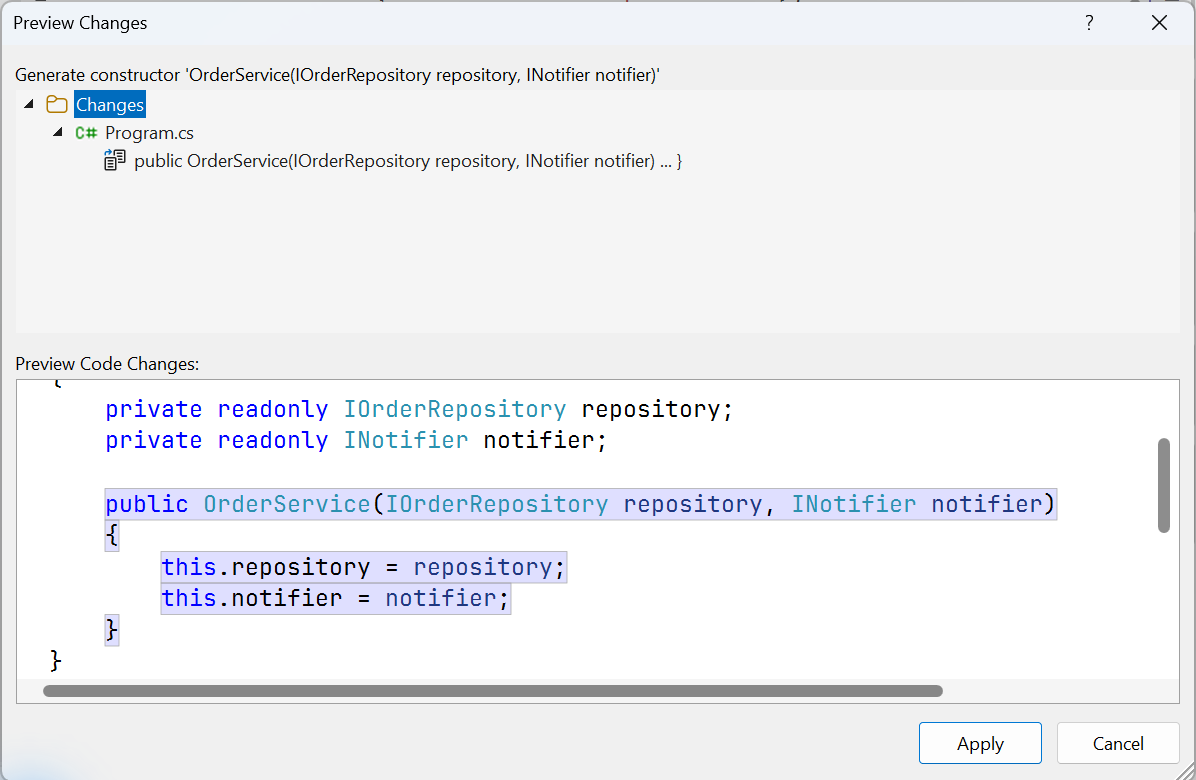
Figure 17.3. Generating a constructor for dependencies
In large applications, objects are created by a DI container. In .NET, this is the Microsoft.Extensions.DependencyInjection library (a NuGet package for console projects, built into ASP.NET Core). Registration defines which implementation to provide and with what lifetime:
cs
using Microsoft.Extensions.DependencyInjection;

ServiceCollection services = new();
services.AddSingleton<INotifier, SmsNotifier>();   // one per program
services.AddTransient<OrderService>();             // new every time
using ServiceProvider provider = services.BuildServiceProvider();

// The container creates SmsNotifier itself and passes it to the constructor.
OrderService service = provider.GetRequiredService<OrderService>();
The package is added through Manage NuGet Packages (Fig. 17.4) or with the command dotnet add package Microsoft.Extensions.DependencyInjection. For the lab assignments, manual constructor injection is sufficient.
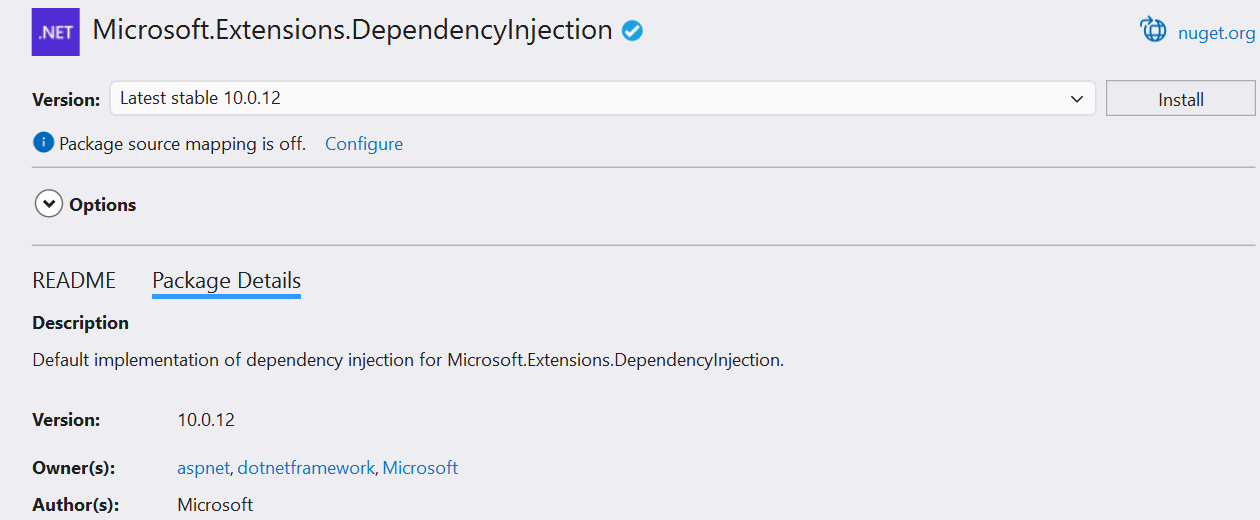
Figure 17.4. Installing the DI container package