
English
Enumerations and tuples
Enumerations
An enumeration (enum) is a value type with a set of named integer constants. Instead of “magic numbers” (0 means new, 1 means paid), code uses meaningful names, and the compiler checks the type:
cs
enum Season { Winter, Spring, Summer, Autumn }     // 0, 1, 2, 3

enum HttpStatus : short
{
    Ok = 200,
    NotFound = 404,
    ServerError = 500,
}
By default, the underlying type is int, and values start at 0 and increase by 1. The underlying type can be changed to any integer type (byte, short, long…), and values can be set explicitly. An enumeration is explicitly cast to a number and back: (int)Season.Summer equals 2, and (Season)3 is Autumn.
Basic operations with enumerations:
season.ToString()returns the constant name ("Summer"); for a value without a name, the number;Enum.Parse<Season>("summer", ignoreCase: true)parses a string and throws an exception on error;Enum.TryParse<Season>(text, true, out var s)parses without an exception;Enum.GetValues<Season>()andEnum.GetNames<Season>()return all values and names;Enum.IsDefined(season)checks whether a value has a name.
A cast does not check the range: (Season)42 is a valid value without a name. The TryParse method also successfully parses the string "42", so a value entered by the user is additionally checked with Enum.IsDefined.
Flag enumerations
If a variable can hold several values at once, the enumeration is declared with the [Flags] attribute, and the constants are assigned powers of two: each occupies a separate bit (Fig. 11.5).
cs
[Flags]
enum Days
{
    None = 0,
    Mon = 1, Tue = 2, Wed = 4, Thu = 8, Fri = 16, Sat = 32, Sun = 64,
    WorkDays = Mon | Tue | Wed | Thu | Fri,
}
Figure 11.5. A flag enumeration as a set of bits
Sets of values are processed with bitwise operators (Topic 2): | is union, & is intersection, & ~ is removal, and ^ is toggling. The HasFlag method checks whether a flag is present: days.HasFlag(Days.Sat) is equivalent to (days & Days.Sat) == Days.Sat. The [Flags] attribute changes ToString: the value 37 is printed as Mon, Wed, Sat rather than as a number.
Enumerations in switch expressions and finite state machines
Enumerations are naturally processed with a switch expression (Topic 3). If not all constants are listed, the compiler issues warning CS8509 and offers the Add missing cases action (Fig. 11.6). Even when all constants are listed, warning CS8524 remains for unnamed values such as (Season)4, so a _ arm that throws an exception is added.
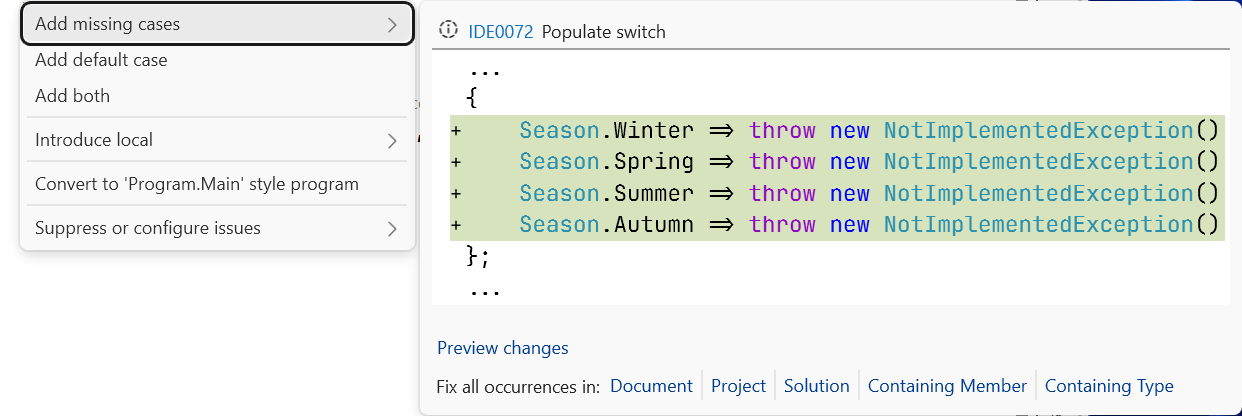
Figure 11.6. Generating switch arms for an enumeration
An enumeration of states and a switch expression on a (state, action) tuple form a finite state machine: an object is in one of the states, and a table defines the allowed transitions (Fig. 11.7). Invalid transitions are handled by the _ arm.
Figure 11.7. A finite state machine for order states
Tuples
A tuple is a lightweight System.ValueTuple structure that groups several values without declaring a separate type. Elements can be given names; without names, they are accessible as Item1, Item2…
cs
(string Name, int Age) person = ("Olena", 21);
Console.WriteLine($"{person.Name}, {person.Age}");

var point = (X: 3, Y: 4);                  // names from the literal
Console.WriteLine(point == (3, 4));         // True
Tuples are value types with mutable fields. The == and != operators compare elements pairwise; element names do not affect the comparison. Most often, a tuple is used to return several values from a method instead of out parameters (Topic 5). A Visual Studio tooltip shows the tuple type with its names (Fig. 11.8).
cs
static (int Min, int Max) Order(int a, int b) =>
    a <= b ? (a, b) : (b, a);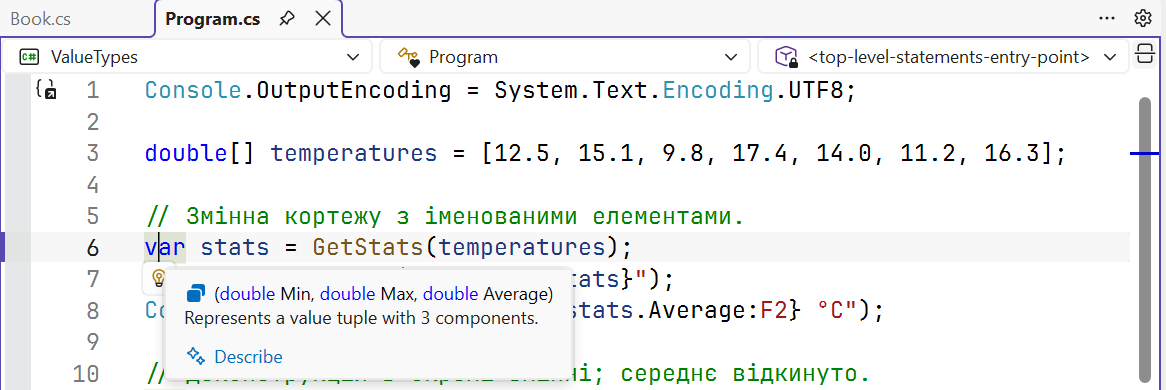
Figure 11.8. A named tuple in a Visual Studio tooltip
Tuples are not suitable for long-lived data with its own behavior: it is better to declare a record. A tuple is appropriate inside a method or class when the values are closely related and used close together.
Deconstruction
Deconstruction breaks a tuple or object into separate variables:
cs
var (min, max) = Order(9, 4);   // new variables: 4 and 9
(min, max) = (max, min);        // swapping values
var (_, top) = Order(9, 4);     // discard: only 9
For your own class or structure, deconstruction is provided by a Deconstruct method with out parameters; records get it automatically:
cs
var (name, course) = new Student("Iryna", 2);
Console.WriteLine($"{name}, year {course}");

class Student(string name, int course)
{
    public string Name { get; } = name;
    public int Course { get; } = course;

    public void Deconstruct(out string name, out int course)
    {
        name = Name;
        course = Course;
    }
}
Positional patterns and property patterns
Patterns (Topic 3) also work with the new types. A positional pattern uses deconstruction, and a property pattern checks property values:
cs
// Point and Book are records from the previous examples.
static string Quadrant(Point p) => p switch
{
    (0, 0) => "origin",
    (> 0, > 0) => "quadrant I",
    (< 0, > 0) => "quadrant II",
    { X: 0 } or { Y: 0 } => "on an axis",
    _ => "quadrant III or IV",
};

static string Era(Book book) => book switch
{
    { Year: < 1900 } => "classic",
    { Author: "Ivan Bahrianyi" } => "Bahrianyi",
    _ => "modern",
};
A tuple in a switch expression lets you analyze several values at once, as in the transition table of a state machine: (state, action) switch { (New, Pay) => Paid, … }.