
English
Overloading and recursion
Method overloading
Overloading means declaring several methods in one class with the same name but different signatures: parameter counts, types, or modifiers (ref, out). The return type is not part of the signature, so methods cannot be overloaded by return type alone. Overloading lets you give the same name to equivalent operations on different data: Math.Round(double), Math.Round(decimal), Math.Round(double, int).
At a call, the compiler chooses the best overload: first it looks for an exact match of argument types, then for the option requiring the least “distant” implicit conversions. If two options are equally suitable, ambiguity error CS0121 occurs:
cs
Console.WriteLine(Describe.Value(5));       // int: 5
Console.WriteLine(Describe.Value(5L));      // long: 5
Console.WriteLine(Describe.Value(5.0));     // double: 5
Console.WriteLine(Describe.Value('A'));     // int: 65
Console.WriteLine(Describe.Value("5"));     // string: 5

static class Describe
{
    public static string Value(int x) => $"int: {x}";
    public static string Value(long x) => $"long: {x}";
    public static string Value(double x) => $"double: {x}";
    public static string Value(string x) => $"string: {x}";
}
There is no exact overload for 'A', so the compiler chooses int because char → int is the best available conversion. If the class had only F(decimal) and F(double), calling F(5) would cause CS0121: int converts equally well to both types.
The Parameter Info tooltip lists method overloads and parameter descriptions. It appears after the opening parenthesis of a call; use its arrows to switch overloads (Fig. 5.4).

Figure 5.4. Tooltip with method overloads
Overloading or optional parameters? If the variants differ only in a few default values, use optional parameters: one method instead of several. If they accept different data types and process them differently, use overloading.
Returning multiple values
A method returns one value, but sometimes several results are needed. There are two approaches: out parameters and a tuple — a parenthesized group of values that can be returned as one result (tuples are covered in detail in Topic 11):
cs
int[] values = [4, -1, 7, 2];

MinMaxOut(values, out int min, out int max);
Console.WriteLine($"out: {min}..{max}");         // out: -1..7

var (low, high) = MinMaxTuple(values);
Console.WriteLine($"tuple: {low}..{high}");     // tuple: -1..7

static void MinMaxOut(int[] a, out int min, out int max)
{
    (min, max) = MinMaxTuple(a);
}

static (int Min, int Max) MinMaxTuple(int[] a)
{
    int min = a[0], max = a[0];
    foreach (int x in a)
    {
        min = Math.Min(min, x);
        max = Math.Max(max, x);
    }
    return (min, max);
}
A tuple is more convenient when all results have equal status; an out parameter fits the TryXxx pattern, where the method returns a success indicator and supplies the result through a parameter.
Recursion
Recursion is a method calling itself. A recursive method solves a problem by reducing it to a smaller problem of the same kind. Every recursive method must have:
- a base case — a condition under which the result is known without a recursive call;
- a recursive step — a call for a smaller problem that is guaranteed to approach the base case.
cs
Console.WriteLine(Factorial(5));      // 120
Console.WriteLine(Gcd(1071, 462));    // 21
Console.WriteLine(Power(2, 10));      // 1024

// n! = n · (n - 1)!, 0! = 1
static long Factorial(int n) => n <= 1 ? 1 : n * Factorial(n - 1);

// Euclid’s algorithm: GCD(a, b) = GCD(b, a % b), GCD(a, 0) = a.
static int Gcd(int a, int b) => b == 0 ? a : Gcd(b, a % b);

// Fast exponentiation: x^n = (x^(n/2))^2.
static long Power(long x, int n)
{
    if (n == 0)
    {
        return 1;
    }
    long half = Power(x, n / 2);
    return n % 2 == 0 ? half * half : half * half * x;
}
Call stack
On every method call, the CLR creates a frame in the call stack containing that call’s parameters and local variables. A recursive method has as many stack frames as its recursion depth: Factorial(4) calls Factorial(3), which calls Factorial(2), and so on until the base case; results then return in reverse order (Fig. 5.5).
Figure 5.5. Call stack of the recursive method Factorial(4)
You can inspect the call stack in the debugger: set a breakpoint at the base case, run the program (F5), and open Debug → Windows → Call Stack. It shows all Factorial frames with parameter values, with Main at the bottom (Fig. 5.6).
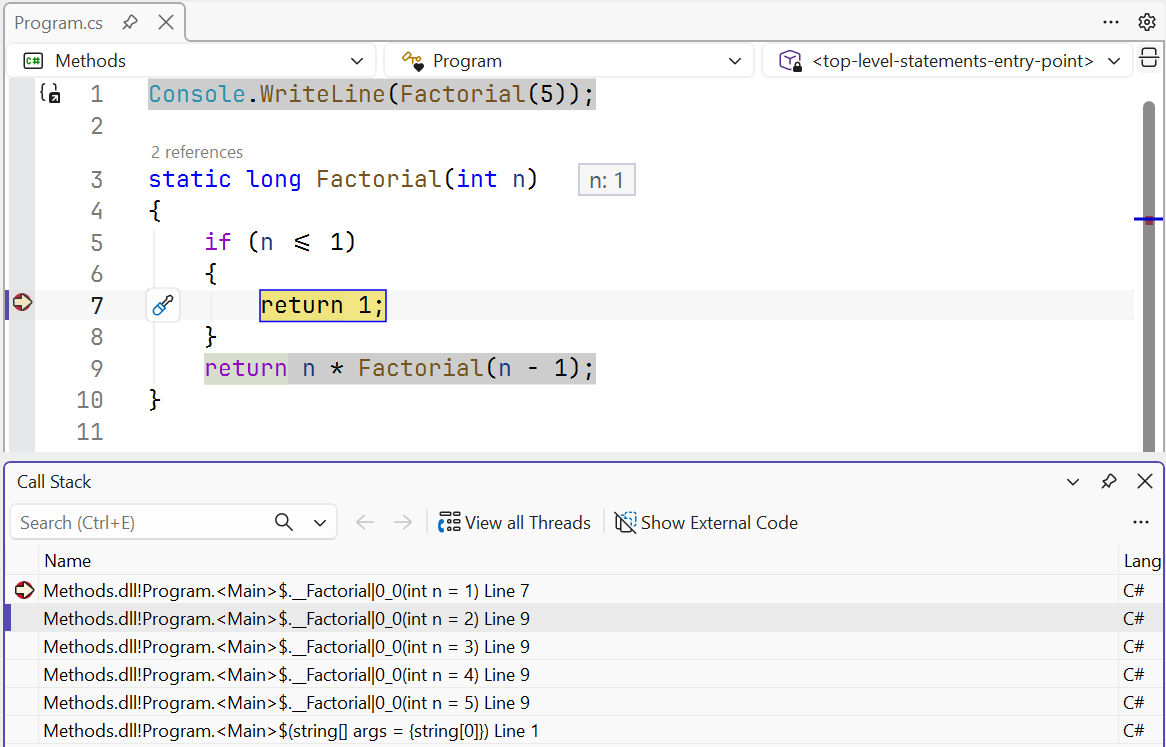
Figure 5.6. The Call Stack window during recursion
Stack overflow
Stack size is limited (typically 1 MB for the main thread). If recursion has no base case or is too deep, the stack overflows and the program crashes: StackOverflowException cannot be caught. A method without a base case
cs
static int Depth(int n) => Depth(n + 1);terminates the program with Stack overflow. and a list of repeated frames. Use recursion for problems with modest depth (tens to thousands of levels): tree traversal, searching alternatives, and divide and conquer. Linear problems such as summing an array or computing a factorial are simpler and more reliable with a loop.
Memoization
Some recursive algorithms compute the same values repeatedly. The method Fib(n) = Fib(n - 1
- Fib(n - 2)
forFib(5)computesFib(3)twice andFib(2)three times (@fig-met-fib); the number
of calls grows exponentially, and Fib(40) requires over 331 million calls. Memoization stores previously computed results, for example in an array: before computing, the method checks whether the result is already known. The “Fibonacci numbers” example compares three approaches.
Figure 5.7. Recursive call tree for Fib(5)
XML comments
Before a method, you can write an XML documentation comment using three slashes ///. Visual Studio generates a template when you type /// above the method declaration. The description appears in IntelliSense tooltips when calling the method (Fig. 5.8) and can be converted into documentation (https://learn.microsoft.com/dotnet/csharp/language-reference/xmldoc/):
cs
Console.WriteLine(Bmi(70, 1.75).ToString("F1"));   // 22,9

/// <summary>
/// Computes the body mass index.
/// </summary>
/// <param name="mass">Mass, kg.</param>
/// <param name="height">Height, m.</param>
/// <returns>Body mass index, kg/m².</returns>
static double Bmi(double mass, double height) =>
    mass / (height * height);
The main tags are <summary> — a brief description, <param name="…"> — parameter description, <returns> — return-value description, and <exception> — exceptions the method can throw.
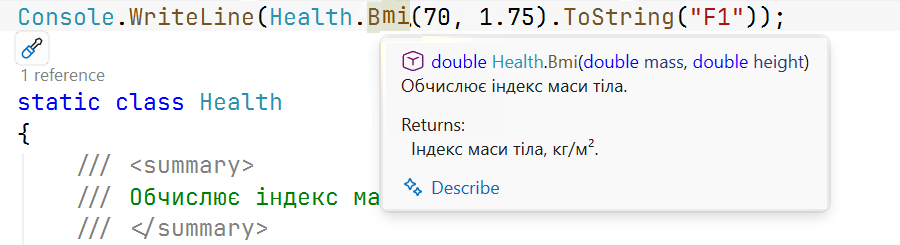
Figure 5.8. An XML comment in the Quick Info tooltip