
English
Lambda expressions and closures
Lambda expressions
A lambda expression is a short notation for an anonymous method right where it is used. The parameters are written to the left of =>, and an expression or a block of statements to the right:
cs
Func<int, int> square = x => x * x;              // expression lambda
Func<int, int, int> add = (a, b) => a + b;       // several parameters
Action greet = () => Console.WriteLine("Hello");   // no parameters
Func<string, bool> isLong = (string s) =>        // explicit types
{
    string trimmed = s.Trim();                   // statement lambda
    return trimmed.Length > 10;
};
Func<int, int, int> first = (x, _) => x;         // discard
Parameter types are usually inferred from the delegate type. If the delegate type is not specified (var), the compiler determines the lambda’s natural type: var square = (int x) => x * x; has the type Func<int, int> (Fig. 14.3). For a lambda without explicit parameter types (var f = x => x;), the type cannot be inferred, which causes error CS8917.
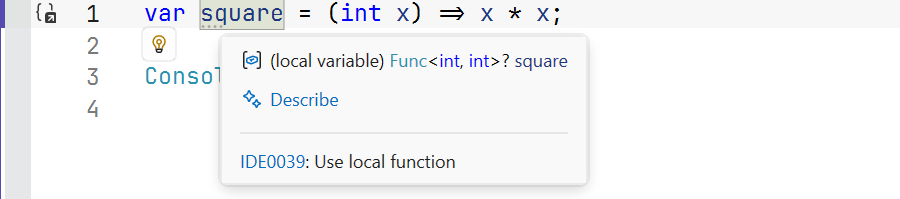
Figure 14.3. The natural type of a lambda expression in a tooltip
The static modifier before a lambda (static x => x * 2) prohibits it from using local variables and instance members of the enclosing code (error CS8820). This guarantees that the lambda does not create a closure. Anonymous methods with the older syntax delegate (int x) { return x * x; } appear in existing code, but new code uses lambda expressions.
Closures
A lambda can use the local variables and parameters of the method in which it is declared. Such a lambda forms a closure: it captures the variable itself, not a copy of its value. The compiler moves the captured variable into a hidden object on the heap, so the variable continues to exist as long as the delegate exists, even after the method returns (Fig. 14.4):
cs
Func<int> next = MakeCounter();
Console.WriteLine(next());   // 1
Console.WriteLine(next());   // 2 – the count variable was preserved

static Func<int> MakeCounter()
{
    int count = 0;
    return () => ++count;
}
Figure 14.4. A variable captured by a closure
During debugging, the values of captured variables are visible in the Locals window when a breakpoint is set inside the lambda (Fig. 14.5).

Figure 14.5. A captured variable in the Locals window
Because the variable itself is captured, all lambdas created in a for loop see one counter variable and, after the loop ends, get its last value. In a foreach loop, the iteration variable is created anew at each step, so there is no such problem. For a for loop, the value is copied into a local variable inside the loop body (the “Counters and the loop variable trap” example).
Higher-order functions
A higher-order function is a method that takes delegates as parameters or returns a delegate. Such functions let you build new functions from existing ones:
cs
// Composition: first f, then g.
static Func<T, TResult> Compose<T, TMiddle, TResult>(
    Func<T, TMiddle> f, Func<TMiddle, TResult> g) =>
    x => g(f(x));

// Memoization: remembering calculated results.
static Func<int, long> Memoize(Func<int, long> slow)
{
    Dictionary<int, long> cache = [];
    return n =>
    {
        if (!cache.TryGetValue(n, out long result))
        {
            result = slow(n);
            cache[n] = result;
        }
        return result;
    };
}

Func<double, double> root = Math.Sqrt;
Func<double, string> format = Compose(root, x => $"{x:F2}");
Console.WriteLine(format(2));   // 1,41
Typical higher-order functions include filtering and sorting with a condition, tabulating a function, retrying an operation (Retry), and measuring the running time of an action. In Topic 15, the LINQ library is built precisely on methods that accept delegates.