
English
Generic methods and classes
Why generics are needed
A method that finds the maximum in an int array differs from the method for double or string only in the type. Writing several copies of the same code is inconvenient, and a shared version using the object type loses type safety. This is exactly how the collections in the first versions of .NET worked, for example, ArrayList:
cs
using System.Collections;

ArrayList values = new() { 10, 20, "thirty" };   // anything
int sum = 0;
foreach (object item in values)
{
    sum += (int)item;       // InvalidCastException on the third one
}
This code has three drawbacks: a type error is detected not by the compiler but by the program at run time; every int is boxed (Topic 11); and explicit casts are needed. Generics eliminate these drawbacks: the data type becomes a type parameter, and the compiler checks every use. Modern code uses only the generic collections of the System.Collections.Generic namespace.
Generic methods
A generic method declares one or more type parameters in angle brackets after its name. When calling it, you usually do not specify the type: the compiler infers it from the arguments:
cs
static void Swap<T>(ref T a, ref T b) => (a, b) = (b, a);

int x = 1, y = 2;
Swap(ref x, ref y);                 // T = int
string s1 = "a", s2 = "b";
Swap<string>(ref s1, ref s2);       // the type is specified explicitly
A type parameter is named with the letter T or with a name prefixed with T: TKey, TValue, TResult. A Visual Studio tooltip shows the inferred type argument (Fig. 13.1).
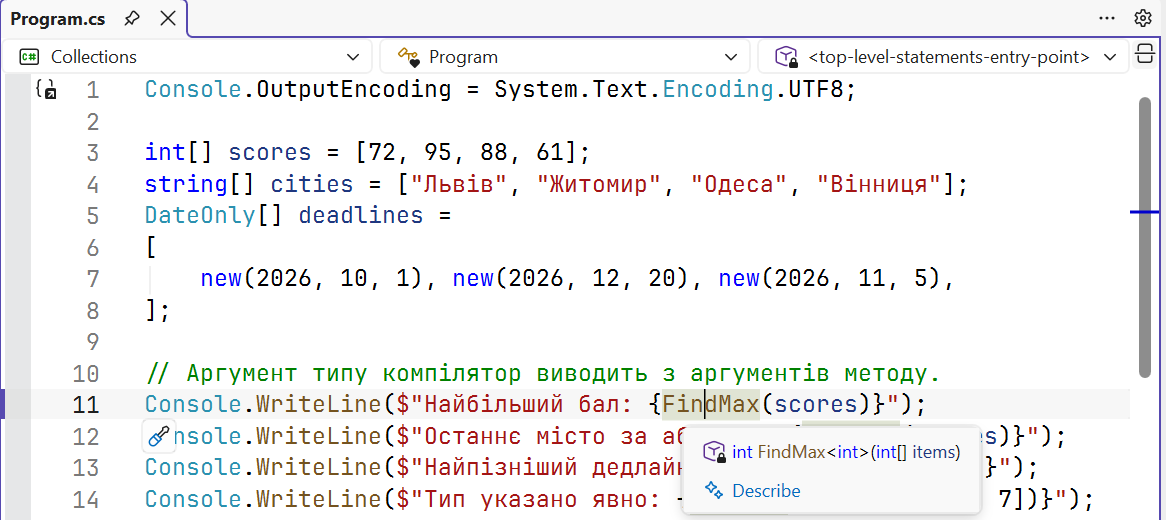
Figure 13.1. The inferred type argument in a tooltip
Generic classes and interfaces
A class, structure, interface, or record can also have type parameters. The generic type Box<T> is open: it is a template from which a closed type such as Box<int> or Box<string> is formed for each type argument (Fig. 13.2). Closed types with different arguments are different types.
cs
Pair<string, int> age = new("Olena", 21);
Pair<DateOnly, double> rate = new(new(2026, 9, 16), 41.25);

class Pair<TFirst, TSecond>(TFirst first, TSecond second)
{
    public TFirst First { get; } = first;
    public TSecond Second { get; } = second;

    public override string ToString() => $"({First}, {Second})";
}
Figure 13.2. Substituting a type argument into a generic class
Inside generic code, the expression default(T), or simply default, gives the “default” value for an unknown type: 0 for numbers, false for bool, and null for reference types. It is used, for example, in the TryPop(out T item) method of a custom stack when the stack is empty.
Type parameter constraints
Without constraints, you can perform only the operations of the object class on an object of type T. To call, for example, CompareTo, the type parameter is constrained with the where keyword:
cs
static T FindMax<T>(T[] items) where T : IComparable<T>Now the compiler allows the call item.CompareTo(max) and does not allow calling the method for a type that does not implement IComparable<T>. Table 13.1 lists the main constraints.
Table 13.1. Type parameter constraints
| Constraint | Requirement for the type argument |
|---|---|
where T : class | a reference type |
where T : struct | a value type (except Nullable<T>) |
where T : notnull | a non-nullable type |
where T : new() | has a public parameterless constructor |
where T : Shape | the Shape class or a class derived from it |
where T : IEntity | implements the IEntity interface |
where T : class, IEntity, new() | several constraints at once |
Generic math (.NET 7) lets you write arithmetic for any numeric type through static abstract interface members (Topic 10). The INumber<T> constraint provides the + and * operators, T.Zero, and so on:
cs
using System.Numerics;

static T Sum<T>(T[] items) where T : INumber<T>
{
    T total = T.Zero;
    foreach (T item in items)
    {
        total += item;
    }
    return total;
}

// Sum([1, 2, 3]) == 6;  Sum([1.5m, 2.25m]) == 3.75m