
English
Operator overloading
Operator overloading
For built-in types, the expression a + b * 2 is natural and clear. If a program has its own mathematical types (fractions, vectors, matrices, amounts of money), calls like a.Add(b.Multiply(2)) are much harder to read. Operator overloading lets you define what +, *, ==, and other operators mean for your own class or structure.
Overload operators only when their meaning is obvious: + for fractions adds fractions. A + operator that adds a product to a shopping cart or saves a file only confuses the code; for such actions, a regular method with a meaningful name is better.
Syntax
An operator is declared as a public static method with the operator keyword. At least one parameter must be of the type in which the operator is declared:
cs
public static Fraction operator +(Fraction x, Fraction y) =>
    new(x.Numerator * y.Denominator + y.Numerator * x.Denominator,
        x.Denominator * y.Denominator);

public static Fraction operator -(Fraction x) =>   // unary minus
    new(-x.Numerator, x.Denominator);
Unary operators (+, -, !, ~, ++, --) have one parameter, and binary operators have two. The operand types can differ: to multiply a vector by a number, you declare two operators, Vector2 * double and double * Vector2, because the compiler does not swap the operands by itself.
The compiler converts an expression with operators into calls to static methods with special names such as op_Addition and op_Multiply (Fig. 12.1). The overload is chosen by the operand types, just as for regular methods (Topic 5). A Visual Studio tooltip shows which operator will be called (Fig. 12.2).
Figure 12.1. Converting an expression with operators into method calls
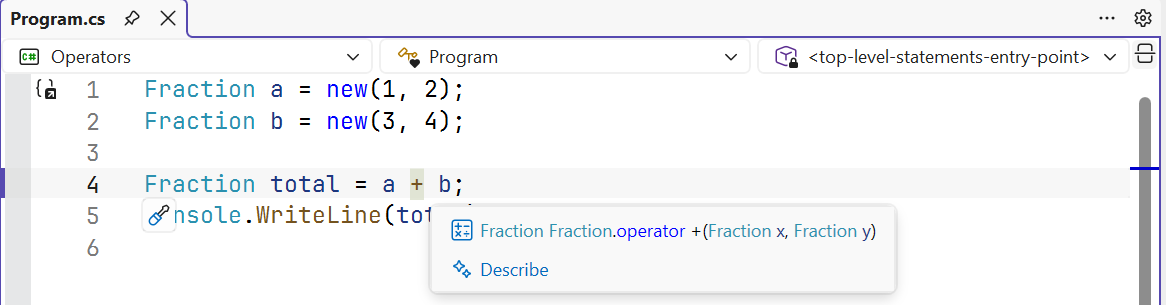
Figure 12.2. An overloaded operator in a Visual Studio tooltip
Comparison operators
Comparison operators are overloaded in pairs: == and !=, < and >, <= and >=. If you declare only one operator of a pair, the compiler reports error CS0216. The == operator must be consistent with the Equals method: otherwise, a == b and a.Equals(b) give different results, and collections (Topic 13) that use Equals and GetHashCode work incorrectly. That is why the compiler issues warnings CS0660 and CS0661 if == is declared without overriding Equals and GetHashCode.
A typical pattern is to implement IEquatable<T> (Topic 10) and express the operators through Equals:
cs
public bool Equals(Fraction other) =>
    Numerator == other.Numerator
    && Denominator == other.Denominator;
public override bool Equals(object? obj) =>
    obj is Fraction other && Equals(other);
public override int GetHashCode() =>
    HashCode.Combine(Numerator, Denominator);

public static bool operator ==(Fraction x, Fraction y) =>
    x.Equals(y);
public static bool operator !=(Fraction x, Fraction y) =>
    !x.Equals(y);
It makes sense to keep the < and > operators consistent with IComparable<T>: if CompareTo returns a negative number, < should return true. Records (Topic 11) generate == and != automatically.
Other operators
The ++ and -- operators are declared as static methods that return a new value; the compiler implements the prefix and postfix forms itself. The true and false operators (also paired) let you use an object in an if condition and, together with & and |, in the && and || operators:
cs
public static bool operator true(Duration d) => d.Minutes > 0;
public static bool operator false(Duration d) => d.Minutes == 0;

if (duration) { /* the duration is nonzero */ }
You cannot overload assignment =, member access ., the conditional operator ?:, or the operators ??, &&, ||, new, is, as, typeof, and nameof. Instead of the [] operator and type casting, you declare indexers and conversion operators, respectively. An attempt to declare, for example, operator && causes error CS1020.
Compound assignment and checked operators
By default, compound assignment a += b is executed as a = a + b: you do not need to declare it separately. For large objects (matrices, buffers), this means creating a new object on every +=. Starting with C# 14, a class can declare its own compound operator as an instance method that modifies the object itself:
cs
class Mileage(long km)
{
    public long Km { get; private set; } = km;

    public static Mileage operator +(Mileage a, Mileage b) =>
        new(a.Km + b.Km);

    // Checked version for a checked context (C# 11).
    public static Mileage operator checked +(Mileage a, Mileage b) =>
        new(checked(a.Km + b.Km));

    // Custom compound assignment (C# 14): no new object.
    public void operator +=(Mileage other) => Km += other.Km;
}
An operator with the checked modifier is called in a checked context (Topic 2) and should throw OverflowException on overflow, while the regular version works without checking. This way, your own numeric types behave like the built-in int and long.
Conversion operators
Conversion operators define casts between your own type and other types. An implicit conversion happens automatically, and an explicit one only with an explicit cast (double)f (Fig. 12.3):
cs
public static implicit operator Fraction(long n) => new(n, 1);

public static explicit operator double(Fraction f) =>
    (double)f.Numerator / f.Denominator;
Figure 12.3. Implicit and explicit conversion
A conversion should be implicit only when it always succeeds and loses no information, like int → long for built-in types. If a loss of precision (the fraction 1/3 as a double) or an exception is possible, the conversion is declared explicit. An implicit conversion from long lets you write a + 2: the compiler converts 2 into a fraction and calls operator +(Fraction, Fraction).