
English
Events
Events
An event is a class member that lets a publisher object notify other subscriber objects that something has happened: the temperature changed, a button was clicked, a download finished. An event is declared with the event keyword and a delegate type:
cs
Button button = new();
button.Clicked += (sender, e) => Console.WriteLine("Clicked");
button.Click();

class Button
{
    public event EventHandler? Clicked;

    public void Click() => Clicked?.Invoke(this, EventArgs.Empty);
}
An event is similar to a public delegate field, but the event keyword restricts access from outside the class: you can only subscribe (+=) or unsubscribe (-=). Only the class itself can raise the event, assign null to it, or replace the list of handlers. An attempt to call button.Clicked(null, EventArgs.Empty) or button.Clicked = null from outside causes error CS0070. A public delegate field has no such protection: any code could raise the “event” or erase all subscribers.
The standard .NET event pattern
Events in .NET are declared according to a single pattern (Fig. 14.6):
- the event type is
EventHandler(an event without data) orEventHandler<TEventArgs>; - the handler has the parameters
object? sender(who raised the event) andTEventArgs e(the event data); - event data is passed in a class derived from
EventArgswhose name ends withEventArgs:TemperatureChangedEventArgs; - the event is raised by a protected virtual method
OnEventName, which derived classes can override; - the event name is a verb or participle:
Clicked,TemperatureChanged,Closing.
Figure 14.6. An event publisher and subscribers
cs
public event EventHandler<TemperatureChangedEventArgs>?
    TemperatureChanged;

protected virtual void OnTemperatureChanged(
    TemperatureChangedEventArgs e) =>
    TemperatureChanged?.Invoke(this, e);
Visual Studio can create a handler with the required signature: after +=, type the name of a new handler and invoke Ctrl+. → Generate method. Fig. 14.7 shows the generated result; replace the stub body with your own event handling.
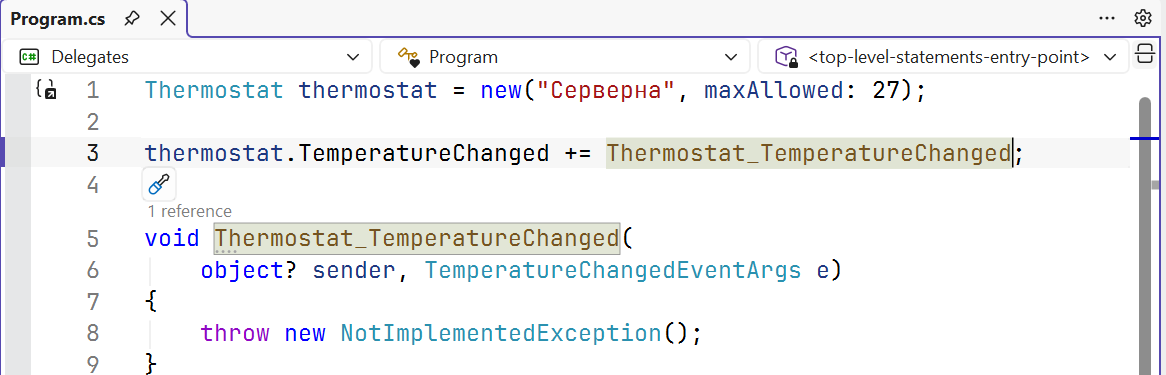
Figure 14.7. A generated event handler
Subscribing, unsubscribing, and the Observer pattern
The publisher keeps references to all subscribers through the delegate’s invocation list. While a subscription exists, the garbage collector will not free the subscriber object, even if it is no longer used anywhere else. That is why a long-lived publisher (for example, a static service) with unremoved subscriptions from short-lived objects causes a memory leak. A subscriber that finishes its work must unsubscribe.
You can unsubscribe a method (-= LogChange) or a delegate stored in a variable. Unsubscribing with a lambda written again (-= (s, e) => …) does not work: it is a new, different delegate object. If you will need to unsubscribe, store the lambda in a variable first.
Events implement the Observer design pattern (Topic 17): the publisher does not know the specific classes of its subscribers, and subscribers can appear and disappear while the program runs. An alternative is a subscriber interface with a method that the publisher calls; it is convenient when there are many logically related events. For event streams, .NET also has the IObservable<T> and IObserver<T> interfaces.