
English
Records
Records
A record is a type intended primarily for storing data. The compiler automatically generates value equality, GetHashCode, ToString, a copy method, and deconstruction for it. The shortest, positional form of the declaration is:
cs
record Book(string Title, string Author, int Year);For each parameter, a read-only property with an init accessor is created, along with a primary constructor and a Deconstruct method. The record declaration is equivalent to record class: a record is a reference type. Compared with a class:
- value equality:
==andEqualscompare the values of all properties and the record type, not references (in Topic 9, you had to overrideEqualsandGetHashCodemanually for this); ToStringprints the type name and property values:Book { Title = Kobzar, … };- the properties of a positional record are immutable:
book.Year = 2025causes error CS8852.
A record can have a body with additional properties, methods, and parameter validation. Fig. 11.3 shows how a record looks in the debugger.
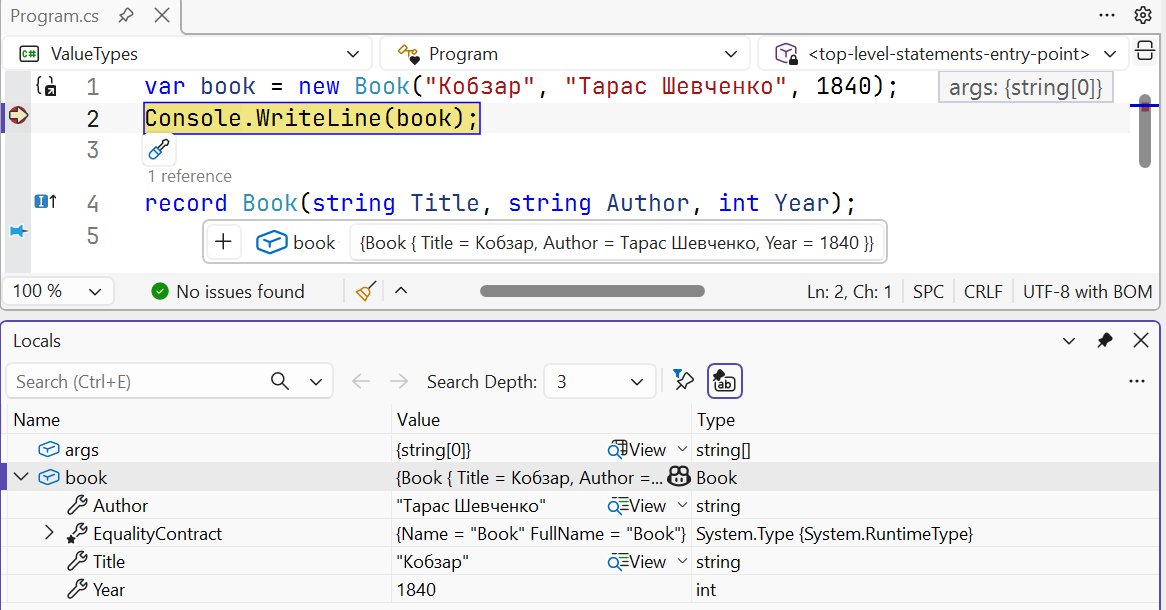
Figure 11.3. Automatic ToString of a record in the debugger
with expressions, deconstruction, inheritance
An immutable record is not changed; instead, a modified copy is created with a with expression: all properties are copied, and those listed in the braces get new values. Deconstruction breaks a record into variables in the order of the positional parameters; unneeded values are discarded with the _ symbol:
cs
Book book = new("Kobzar", "Taras Shevchenko", 1840);
Book reprint = book with { Year = 2024 };
var (title, _, year) = reprint;     // "Kobzar", 2024
A record can inherit only from another record. A derived record passes parameters to the base one, and equality also checks the type: a Book and an EBook with the same title, author, and year are not equal. with expressions also work for structures and anonymous types.
A positional record shortens a data declaration compared with a class with a primary constructor and properties (Fig. 11.4); in addition, it gets value equality and the other generated record members.
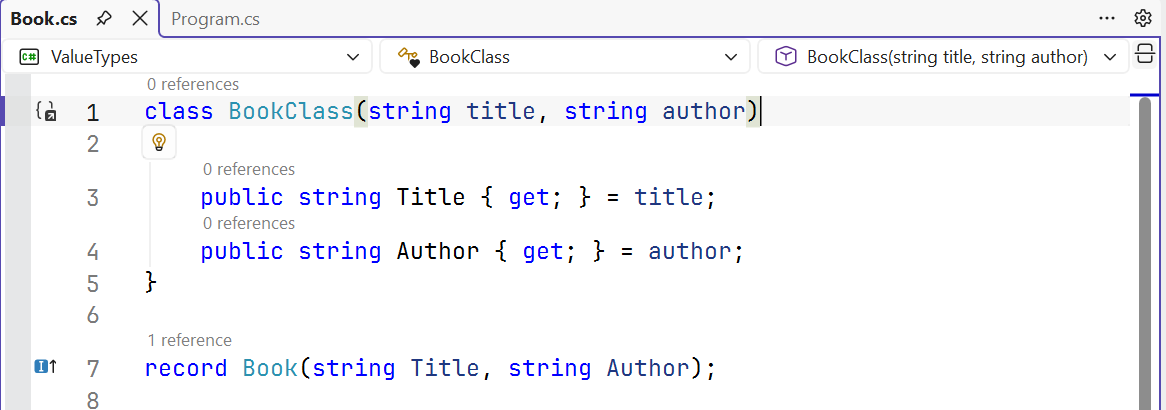
Figure 11.4. A class with properties and a positional record
record struct and choosing a type
The record struct declaration creates a record structure: a value type with generated Equals, ==, GetHashCode, ToString, and deconstruction. Unlike record class, the properties of a positional record struct are mutable (get; set;). An immutable record structure is declared as readonly record struct:
cs
record struct Size(int Width, int Height);          // mutable
readonly record struct Point(double X, double Y);  // immutable
Table 11.1 summarizes the options.
Table 11.1. Comparison of classes, structures, and records
| Feature | class | struct | record | record struct |
|---|---|---|---|---|
| kind of type | reference | value | reference | value |
| equality | of references | of fields | of values | of values |
== generated | no | no | yes | yes |
ToString with data | no | no | yes | yes |
| positional properties immutable | – | – | yes | with readonly |
with expression | no | yes | yes | yes |
| inheritance | yes | no | from records | no |
Practical recommendations: entities with behavior and identity (an account, a user) are classes; immutable data compared by value (a book in a catalog, a message, a calculation result) are records; small values (a point, an amount of money, a color) are readonly struct or readonly record struct.