
English
Bounds, modifications and algorithm walkthroughs
Bounds, modifications and state checking
A vector is a safe owner of memory, but it does not fix a faulty indexing algorithm. In Debug the library may detect out-of-bounds access, but Release is not obliged to repeat the same message. In the lab, use bounds checking before access; run a deliberate violation only as a separate diagnostic experiment, not as a working solution.
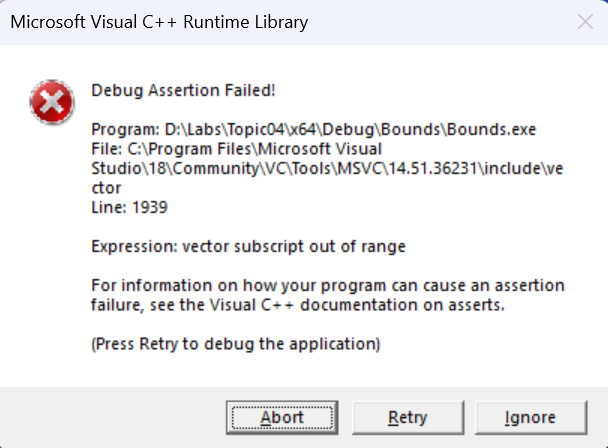
Figure 4.6. Diagnosing an invalid index in Debug
When removing elements during an index-based traversal, the next element moves into the current place. If you immediately increment the index, it will be skipped. The options: do not increment the index after removal, traverse from the end, or build a separate vector of the elements that must be kept. For a beginner the third way is often the clearest.
Writing const auto& first = values[0] followed by push_back can create a dangling reference when the buffer changes. If you need the value itself, store a copy. If you need to find an element after structural changes, use a stable key of the record and search again. Even an index can become wrong after an insertion before the corresponding element.
Independent checks
For searching, prepare an empty collection, a single element, a match at the beginning, in the middle, at the end and a missing key. For sorting, check that the order is correct and that none of the original elements were lost and no extra ones appeared. Duplicates are especially useful for checking this property.
For a string algorithm, the important cases are an empty string, only delimiters, a single token and several consecutive delimiters. Explicitly decide whether empty fields are counted. Splitting “words by spaces” and parsing CSV are different problems: in CSV, quotes can allow a delimiter inside a field. Do not call a simple split a full-fledged CSV parser.
For matrices, also use 1×N and N×1. If the algorithm takes the neighbors of a cell, corners and edges have fewer neighbors. Checking each coordinate must precede indexing, not follow it. These tests check the data structure, not just one expected console text.
Walking through algorithms on small data
An index-based algorithm is easier to understand on a short sequence for which you can write out every state. Take the values 7,2,5,2. In selection sort, at the first step the smallest value 2 is found at position 1. After swapping it with position 0 we get 2,7,5,2. At the second step the search starts at position 1 and finds 2 at position 3. The result 2,2,5,7 is already ordered, but the algorithm still completes the planned steps of checking the rest.
Table 4.1. The selection sort invariant
| Step | Ordered prefix | Part not yet processed |
|---|---|---|
| 0 | empty | 7, 2, 5, 2 |
| 1 | 2 | 7, 5, 2 |
| 2 | 2, 2 | 5, 7 |
| 3 | 2, 2, 5 | 7 |
| 4 | 2, 2, 5, 7 | empty |
The key statement: the processed prefix contains the smallest elements in the correct order. The inner loop does not change the data but only remembers the position of the best candidate. One swap is performed after the search is complete. If you swap on every comparison, it will be a different algorithm with different properties; it can also be written correctly, but the explanation must match the actual code.
Sort stability means preserving the relative order of records with the same key. For plain numbers the difference is not visible, but for students with equal scores it matters. Add a name to each number: 7 A,2 B,5 C,2 D. A swap can reorder equal keys relative to other records. If the problem requires alphabetical order for equal scores, this is already an additional comparison key, which should be explicitly implemented and checked.
Binary search without missed bounds
Let a sorted sequence have the values 2,5,8,11,14,17. The initial interval [0,6) contains all six positions. When searching for 14, the middle is 3, and the value 11 is less than the key. So the left bound becomes 4, and the new interval is [4,6). The middle 5 contains 17, so the right bound becomes 5. What remains is [4,5), where 14 is found.
If we were searching for 13, the last comparison with 14 would reduce the right bound to 4. The interval [4,4) is empty, so the result is “not found”. The continuation condition is left < right. Each step either increases the left bound or decreases the right one, so the length of the interval decreases. Assigning left = middle instead of middle + 1 can leave the same interval and create an infinite loop.
With repeated keys, an ordinary search returns some match, but not necessarily the first one. If you need all records, define a separate problem of finding the left and right bounds of the group. Do not keep reading neighbors without checking the index: the group may start at 0 or end with the last element.
Insertion and removal as a change of the model
In a shopping list, index 1 may denote “tea”. After inserting a new item at the beginning, tea will have index 2. If the program stored 1 as the “tea identifier”, it will now modify another item. This is a problem of the data model, even if all indices formally stayed within bounds. For a stable reference to a record, a separate id field is added.
Let us consider removing all negative numbers from the vector {-2,-3,4}. After removing position 0 we get {-3,4}. If you increment i to 1, the number −3 will not be checked. A correct index-based loop leaves i unchanged after erase and increments it only when the current element is kept. This preserves the invariant “all positions before i have already been checked”.
Another approach creates an empty result and adds to it only non-negative values. Its advantages are a simple traversal and no shifts while reading. The drawback is additional memory. For teaching data sizes this is often a good price for clarity. After finishing, you can replace the original vector with the result.
Do not perform structural removal from the same vector inside an ordinary range-based for without understanding the iterator validity rules. The hidden traversal mechanism can be broken by the change. The ability to modify values through auto& does not mean the ability to safely modify the structure of the collection itself.