
English
Iterators and invalidation
A position instead of a tie to the container
A search algorithm should not need separate knowledge of how vector and list are built. An iterator provides a position interface: read the current value, move to the next one, and compare with a bound. Moving to the next position can be implemented as incrementing a pointer or as following a link between nodes. The fact that an operation is available does not mean it has the same cost.
The range [first,last) includes first and excludes last. An empty range has equal bounds. This notation lets you join subranges one after another and does not need a special address for the last element of an empty container. The end iterator serves as a bound, not a value; dereferencing end does not become valid even when the container is not empty.
Figure 14.1. Half-open bounds and reverse traversal
begin and end of a mutable container usually give access for changing the elements. cbegin and cend give const iterators. A const iterator itself can be moved; const applies to the element accessible through it. In contrast, a const variable holding an ordinary iterator cannot be moved, although its element may remain mutable. These are two different levels of immutability.
A reverse iterator represents a position through a base iterator located after the corresponding element: rbegin().base() == end(). That is why converting a position for erase requires care. rend is not dereferenced either. For an ordinary reverse traversal, prefer the ready-made rbegin/rend or views::reverse rather than manually stepping before the start of an array.
Categories and algorithm requirements
An input iterator reads a single-pass sequence, like a stream. A copy of such an iterator does not promise an independent repeated traversal. Forward adds multi-pass traversal, bidirectional adds moving backward, and random access adds jumps by a distance and the difference between positions. Contiguous additionally guarantees correspondence with the order in memory. Output iterators form a separate group for writing, not a step in the nested chain of reading.
Figure 14.2. Refinement of iterator categories
std::next(it,n) does not change the original variable it; it returns a moved copy. For a list, it performs n steps; for a vector, it can use constant-time arithmetic. std::distance(first,last) can likewise be linear. Calling distance from the start of a list on every iteration is a way to accidentally get a quadratic algorithm from a loop that looks simple.
std::sort requires random access. For a list, use the list::sort member function rather than hoping that any begin/end pair is enough. In ranges, these preconditions are expressed with concepts. A custom iterator does not become random access just by declaring the corresponding tag: it must implement the operations, the complexity, and the semantic laws.
A sentinel can have a different type than the iterator. It answers the question “has the end been reached?” but is not required to be able to read an element. This is convenient for generators and streams. For an algorithm that requires bounds of the same type, you sometimes need a common view; it is better to first check whether a suitable ranges algorithm exists.
Invalidation: A structural change changes positions
Reallocation of a vector invalidates all iterators, references, and pointers to its elements. Without reallocation, an insertion can still invalidate positions at the insertion point and after it. Removal shifts the tail; the old end should not be used either. Reserve helps you control reallocation, but it does not cure all forms of invalidation.
The nodes of list and map usually survive the insertion of other elements. Removing a specific node invalidates references to it. Deque has separate rules for the ends and the middle: insertion at the ends does not break references to existing elements, but iterators become invalid. Unordered containers lose their iterators on a rehash, although references to elements that have not been removed are preserved.
The safest starting strategy is not to change the structure during a range-for. If you need to remove elements, use erase_if or an explicit loop with the iterator returned by erase. Storing an index instead of an iterator does not solve the problem automatically: after a removal, the index may refer to a different element.
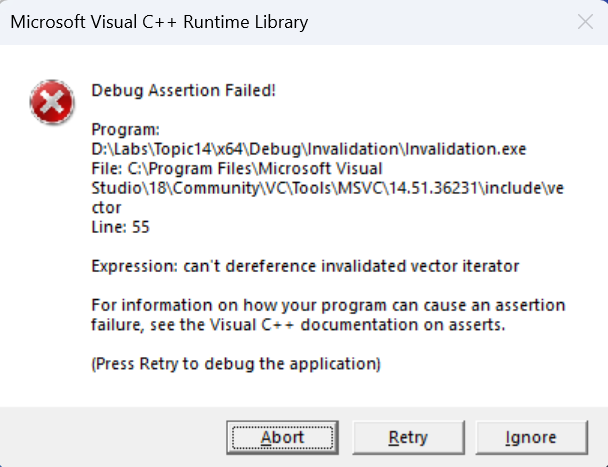
Figure 14.3. Diagnosing a violated iterator guarantee in Debug
The implementation’s Debug checks are useful, but they are not the portable semantics of the standard. In Release, the error may not show up as a message and still remain incorrect. Do not use the absence of a crash as proof that an iterator is valid. Keep negative examples separate from the runnable teaching programs.
remove, erase, and output iterators
The remove_if algorithm moves the elements that remain to the start of the given range and returns the new logical bound. It does not know how to change the size of an arbitrary container. The tail still holds live objects with valid but unspecified values for this purpose. This is not uninitialized memory.
Figure 14.4. Logical filtering and physical shrinking of a vector
cpp
auto last = std::remove_if(values.begin(), values.end(),
    [](int x) { return x < 0; });
values.erase(last, values.end());
For the supported standard containers, C++20 std::erase_if(values,predicate) expresses this intent more concisely. The list::remove_if member function removes the nodes itself, so you should not mechanically apply the explanation of the remove_if algorithm to it.
Copying algorithms need enough room at the destination. A copy to the begin of an empty vector does not create elements and results in an invalid write. std::back_inserter(target) turns writing into push_back. For a known size, you can call resize first, but reserve by itself is not enough. Stream iterators let you read or write sequentially, but the single-pass nature of an input stream limits repeated passes.