
English
Associative and hash containers
set and map: uniqueness through ordering
set stores keys, and map stores key-value pairs. Uniqueness is defined by the comparator’s equivalence: if neither a < b nor b < a, the container considers the keys equivalent. This can differ from operator ==, for example with a case-insensitive comparison. The comparator must define a strict weak ordering; <= is not suitable for this because it is true for equal values.
multiset and multimap allow equivalent keys. lower_bound(k) finds the first element that is not less than k according to the comparator. equal_range(k) gives a pair of bounds for the whole group of equivalent keys. This is a half-open range: the right bound does not belong to the result. Do not dereference end, even if the search is the only operation before it.
Figure 13.4. An example of a balanced key tree
The access member functions have different consequences. map[key] adds a missing key with a default value. That is appropriate for a counter, but it changes the dictionary during “reading.” at(key) does not insert; it throws out_of_range. find returns an iterator or end, and contains returns just a bool. A const map has no operator [] precisely because it may insert.
insert does not replace the value of an existing key. insert_or_assign performs the replacement explicitly. try_emplace does not construct the mapped value from the passed arguments inside the container if the key already exists; however, the argument expressions of the call are still evaluated. Do not put an expensive function in an argument on the assumption that it will not be called.
A phone book
Problem. Add contacts, do not overwrite a number with a repeated insertion, and find and remove an entry.
cpp
#include <map>
#include <print>
#include <string>

int main()
{
    std::map<std::string, std::string> phoneBook;
    phoneBook.try_emplace("Olena", "101");
    auto [it, added] = phoneBook.try_emplace("Olena", "999");
    std::println("added: {}, phone: {}", added, it->second);
    phoneBook.insert_or_assign("Taras", "202");
    if (auto found = phoneBook.find("Taras");
        found != phoneBook.end())
        std::println("found: {}", found->second);
    phoneBook.erase("Taras");
    for (const auto& [name, phone] : phoneBook)
        std::println("{}: {}", name, phone);
    std::println("missing: {}", phoneBook.contains("Ira"));
}
Output:
text
added: false, phone: 101
found: 202
Olena: 101
missing: false
When an insertion fails, the returned iterator points to the existing entry. Names are printed in key order, not in insertion order. The sample numbers are strings: no arithmetic is needed on them, and leading zeros must be preserved.
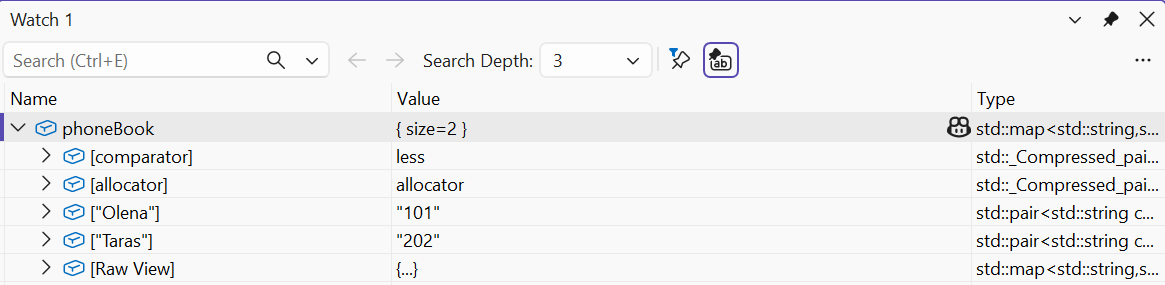
Figure 13.5. An ordered dictionary in the Watch window
Unordered containers and hashing
A hash function turns a key into a number used to choose a bucket. Different keys can have the same hash: this is a collision, not an equality error. After choosing a bucket, the container uses an equality comparison. Keys that are considered equal must have the same hash. The converse is not required; otherwise the hash would have to be a unique code for every possible object.
Figure 13.6. Hash, buckets, and the equality check
load_factor is the ratio of the number of elements to the number of buckets. max_load_factor sets the growth policy. reserve(n) plans space for the expected number of elements according to that policy. Rehashing rebuilds the placement in buckets and invalidates iterators, but not references or pointers to elements that have not been removed. The iteration order is not stable across implementations, runs, or rehashes.
A frequency dictionary naturally uses ++counts[word]: a missing int value is initialized to zero. To print a reproducible report, we move the result into a vector and sort it separately. You do not always need to change the container just to get the desired output order.
Word frequency
Problem. Count the words in a given string and print an alphabetical report.
cpp
#include <algorithm>
#include <print>
#include <sstream>
#include <string>
#include <unordered_map>
#include <utility>
#include <vector>

int main()
{
    std::istringstream input("red blue red green blue red");
    std::unordered_map<std::string, int> wordCount;
    for (std::string word; input >> word;)
        ++wordCount[word];
    std::vector<std::pair<std::string, int>> report;
    for (const auto& item : wordCount)
        report.push_back(item);
    std::sort(report.begin(), report.end());
    for (const auto& [word, count] : report)
        std::println("{}: {}", word, count);
}
Output:
text
blue: 2
green: 1
red: 3
Here the separators are whitespace characters; case and punctuation are not normalized. For Ukrainian text, a byte-by-byte tolower does not provide Unicode normalization. Define the rules for a word before writing a more complex analyzer. Sorting pairs compares the first field first, which matches the key of the report.
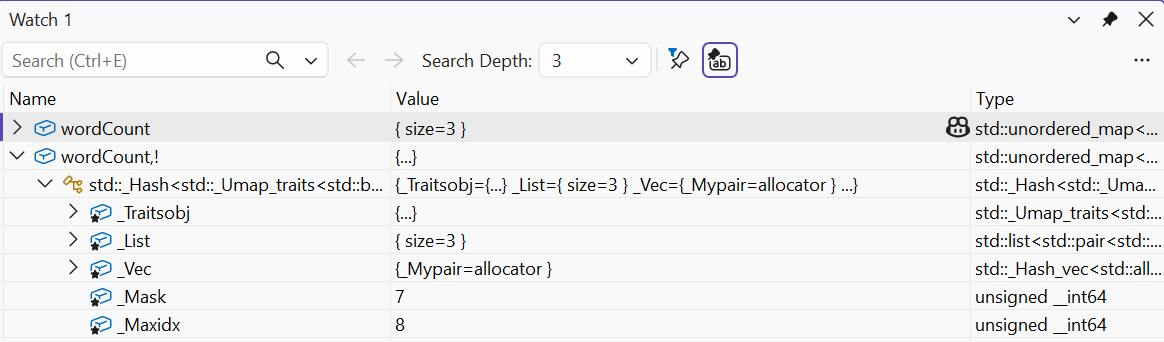
Figure 13.7. Logical and raw views of a hash dictionary
A custom key and a consistent hash
In the custom Point type, equality compares both coordinates. The hash also uses both, but its arithmetic is no proof that there are no collisions. A test of the container should include a repeated key, a missing key, and different keys. In a separate test it is useful to deliberately use a constant hash: correctness is preserved, although lookup becomes slower. This separates correctness from hash quality.
Instead of specializing std::hash<Point>, you can pass your own functor as the second template argument of unordered_set, as in the example. That way the policy is visible in the container type and does not require opening namespace std. If a std::hash specialization is still needed, it must be for a permitted user-defined type and meet the library requirements. Do not add arbitrary new functions to namespace std.
Points in a hash set
Problem. Store two different points, reject a repeated one, and test lookup.
cpp
#include <cstddef>
#include <functional>
#include <print>
#include <unordered_set>

struct Point {
    int x, y;
    bool operator==(const Point&) const = default;
};

struct PointHash {
    std::size_t operator()(const Point& p) const noexcept {
        auto hx = std::hash<int>{}(p.x);
        auto hy = std::hash<int>{}(p.y);
        return hx ^ (hy + 0x9e3779b9u + (hx << 6)
            + (hx >> 2));
    }
};

int main()
{
    std::unordered_set<Point, PointHash> points;
    points.reserve(8);
    points.insert({1, 2}); points.insert({1, 2});
    points.insert({2, 1});
    std::println("size: {}", points.size());
    std::println("found: {}", points.contains({1, 2}));
    std::println("missing: {}", points.contains({9, 9}));
}
Output:
text
size: 2
found: true
missing: false
The mixing operations are performed on unsigned size_t, where overflow has well-defined modular arithmetic. This is not a cryptographic hash and does not protect against deliberately crafted keys. The coordinates of a set element are not changed in place: you must remove the old key and insert a new one.