
English
Parameter packs and requires
Parameter packs and fold expressions
The pack Args... denotes a sequence of types, and args... denotes the corresponding function parameters. A pack is not a run-time container: it can contain different types and has no push_back method. sizeof...(Args) gives the number of arguments as a constant value. Expanding a pack repeats a certain expression pattern for each element of the pack.
A fold expression with the comma operator performs the output operations in sequence. An empty pack is allowed for a unary fold over the comma; for adding with +, you must either forbid an empty pack or provide an initial value in a binary fold. The initial 0 also sets the initial accumulation type, and this can matter for mixed numeric arguments.
Figure 12.2. From an argument pack to sequential operations
A table row of arbitrary length
Problem. Print a header, a mixed row and a row without fields.
cpp
#include <print>

template<class... Args>
void row(const Args&... args)
{
    std::print("|");
    ((std::print(" {:>8} |", args)), ...);
    std::println();
}

int main()
{
    row("item", "count", "price");
    row("pen", 3, 12.5);
    row();
}
Output:
text
|     item |    count |    price |
|      pen |        3 |     12.5 |
|
All arguments are passed by const&; the function does not keep any references after it returns. Each type must support formatting. The minimum width of 8 does not truncate long text, so a row with a long name will widen the table. A guaranteed width needs a separate truncation or wrapping policy; it should not be quietly added to a general-purpose print.
Forwarding with Args&&... and std::forward<Args>(args)... preserves value categories in a template wrapper. But unconditionally moving from every argument would break calls with lvalues. A forwarding reference arises under specific type deduction rules; const T&& is not a forwarding reference. In a print function, forwarding gives no real advantage, so plain const& expresses the intent more precisely.
Pack indexing Ts...[0] is a C++26 feature and does not replace a run-time loop. Before using it, check __cpp_pack_indexing and compile a separate small example. It is not required in the training solution for this topic; ordinary pack expansion works without it.
The requires clause, the requires expression and standard concepts
A requires clause attaches constraints to a template. A requires expression checks whether the listed requirements are valid in a dependent context and yields a Boolean result. Inside the list, you can check that an expression is valid, that a nested type exists, a property of the result and the absence of exceptions. The parameters of such an expression are hypothetical and do not create objects at run time.
cpp
template<class T>
concept Addable = requires(T a, T b) {
    { a + b } -> std::same_as<T>;
};
template<Addable T>
T add(T a, T b) { return a + b; }
The same_as<T> check requires exactly this result type. For two short values, the result of addition usually has type int, so this concept rejects short. If the contract allows a conversion, you can use convertible_to<T>, but that does not guarantee the absence of narrowing or loss of value. Read a constraint as an exact condition, not as an approximate name.
std::invocable<F, Args...> checks that a call is possible; it does not promise that the function does not change state or always returns the same result. std::totally_ordered checks the syntax of comparisons and has semantic requirements that the compiler cannot prove for arbitrary code. NaN values in floating-point numbers are especially important here: the availability of operators does not make all possible values ordered in the sense the task requires.
Concepts are combined with && and ||. Our Numeric is a union of two groups, not a refinement of each of them. In the diagram, the refinement arrows point from the stronger requirement to the weaker one. regular includes semiregular and equality comparison; copyability alone does not guarantee meaningful equality.
Figure 12.3. Composing requirements and the direction of refinement
Diagnostics and negative tests
A concept moves the error message closer to the interface. Without a constraint, the compiler may go deep into the body and report a missing operator. With a constraint, it first rejects the candidate, and the details explain which requirement is not satisfied. This does not mean that every message involving a concept is short: a combination of many overloads also requires reading the full build log.
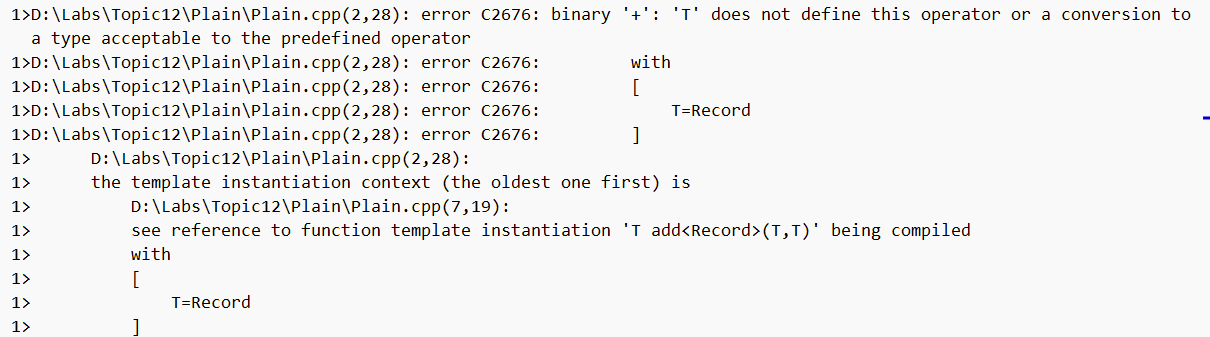
Figure 12.4. Failure during instantiation of an unconstrained template

Figure 12.5. Failure because Addable is not satisfied
static_assert is useful for properties that must hold unconditionally in the chosen specialization. A concept, in contrast, takes part in selecting a candidate. For example, overloads for integers and floating-point numbers are naturally separated by concepts; a call with an invalid capacity of an already selected class can be explained with your own static_assert. Traits from <type_traits> such as is_trivially_copyable_v<T> describe individual technical properties. Do not use them to replace the full contract of serialization or resource ownership.
A negative test must be a separate file that is expected not to compile. Do not leave an invalid call in the working main, and do not declare a check successful just because the line is commented out. Write down the kind of error, the required constraint and the command that reproduces the failure.
Static polymorphism and the final choice
A function constrained by the Shape concept can call area() of different unrelated classes. This is static polymorphism: the choice is known at instantiation time. It does not automatically create a single container of heterogeneous shapes. For such a container, a virtual interface, variant or another explicitly chosen form of type erasure is appropriate.
CRTP passes a derived class as a parameter of the base, for example Base<Derived>. The base class can access the derived implementation without a virtual call. But this creates a stronger dependency between the classes and requires care during construction and destruction. In this topic, CRTP is an overview; a free function with a concept is often simpler. An optimization must be proven by measurement, not by the mere absence of virtual.
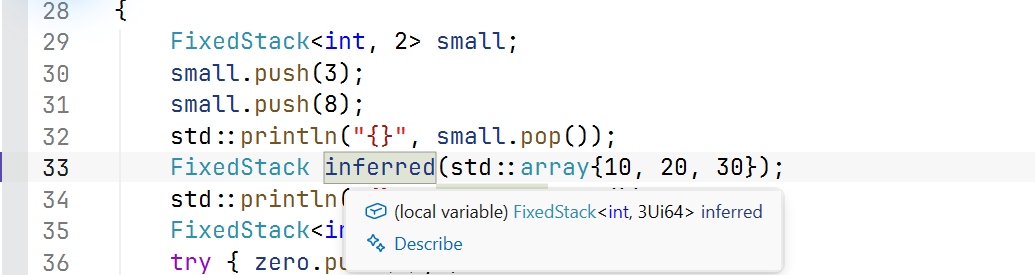
Figure 12.6. Template editor with concrete arguments