
English
Dynamic memory and its errors
Manual dynamic memory
new int{5} allocates memory and creates an int with the value 5. delete p destroys and releases a single object created by the matching new. An array new int[n]{} requires delete[] p. Mixing these pairs is not allowed, even if the elements are simple. delete nullptr is safe, but a repeated delete of the same non-null owned resource is an error.
Plain new reports a failed allocation with the exception std::bad_alloc. The form new (std::nothrow) from <new> returns nullptr instead of throwing that exception. It doesn’t make subsequent work safe automatically: you must check the result before writing. Modern code prefers containers and smart pointers, which take ownership immediately.
Example 2. Growing an array manually
The program shows the mechanism that a container hides. First there is a buffer for two values. The new buffer is created before the old one is released; the data is copied, the old one is released, and the owner’s address is updated.
cpp
#include <print>
#include <new>

int main()
{
    int* values = new (std::nothrow) int[2]{10, 20};
    if (!values) return 1;
    int* larger = new (std::nothrow) int[4]{};
    if (!larger)
    {
        delete[] values;
        return 1;
    }
    for (int i = 0; i < 2; ++i) larger[i] = values[i];
    delete[] values;
    values = larger;
    larger = nullptr;
    values[2] = 30;
    values[3] = 40;
    for (int i = 0; i < 4; ++i) std::print("{} ", values[i]);
    std::println();
    delete[] values;
    values = nullptr;
}
Output: 10 20 30 40. The check of the second allocation must release the first buffer on failure. This extra branch illustrates the complexity of manual ownership. If later output throws an exception, the manual cleanup may not run; a production solution should use vector or unique_ptr. The example deliberately demonstrates the mechanics, not a general-purpose container.
A pointer to values[0] saved earlier becomes dangling after delete, even if the new buffer contains the same number. Assigning nullptr changes only one variable, not all copies of the address. That is why “I set p to null after delete” is not a complete solution to the lifetime problem.
Memory errors and diagnostics
A leak occurs when a resource is still allocated, but the program has lost the means to release it correctly. A dangling pointer stores the address of an object that has already been destroyed. A double free means releasing the same resource again. All three situations have different causes, so a single check for nullptr is not enough.
AddressSanitizer adds memory access checks and can detect out-of-bounds access and use after free. In MSVC, you enable it with /fsanitize=address. For debug information, use /Zi, not /ZI. The incompatible /RTC, Edit and Continue and incremental linking must be turned off. Documentation: https://learn.microsoft.com/cpp/sanitizers/asan.
Read a sanitizer report starting from the first invalid access: the error type, the line of the read or write, the allocation site and the release site. Don’t change arbitrary numbers in the code to make the report disappear. You need to fix the bound or the ownership rule. The absence of a report on one run doesn’t prove the absence of all defects.
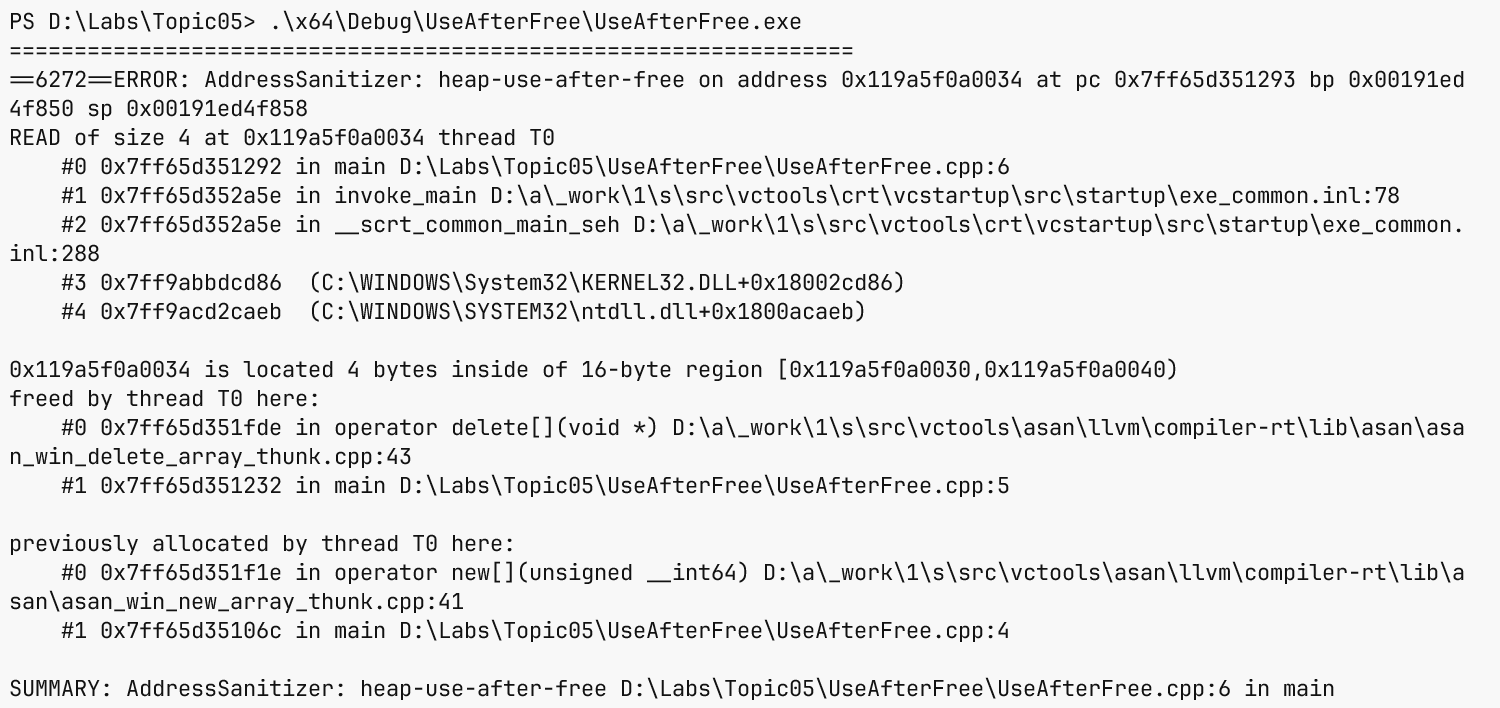
Figure 5.4. Diagnosing use after free
The CRT Debug Heap in the MSVC Debug configuration can report unreleased allocations via _CrtDumpMemoryLeaks() from <crtdbg.h>. This is a feature of a specific implementation, not a standard C++ function. Get the report after the owners are destroyed; otherwise a live, intended object may be mistakenly called a leak.

Figure 5.5. CRT report of unreleased memory