
English
Memory and pointers
Memory, objects and storage duration
A program object occupies a region of memory and has a lifetime. Value, address and owner are different characteristics. The value of an integer object may be 5, its address is where it is located, and its owner is the object or scope responsible for ending its lifetime. A pointer stores an address, but the mere fact that it stores an address doesn’t tell you who must release the resource.
Automatic local objects live within the corresponding call or block. An implementation often places them on the stack, but the standard describes storage duration, not the mandatory physical location of each variable. Static objects exist for a long period of the program’s execution. Dynamic objects are created by a separate operation and need a defined mechanism for releasing them (Fig. 5.1).
Figure 5.1. The main categories of program memory
In popular diagrams the stack and the heap grow toward each other, but the real virtual address space of a modern OS is more complex. Don’t use such a diagram for arithmetic comparison of addresses of independent objects. The operating system and security mechanisms may change addresses between runs. A test should check behavior, not a specific hexadecimal address.
Ownership is responsibility for a resource. The owner must end its lifetime exactly once and no earlier than all permitted accesses have finished. Modern C++ expresses this through owner objects: vector owns a buffer, string owns text, unique_ptr owns a single dynamic resource. These objects are what usually replace manual new/delete.
Pointers and access operations
A pointer of type int* can store the address of an int or the null value nullptr. The operation &value takes an address, and *pointerdereferences the pointer, that is, accesses the object at the address. The same symbol * can mean different things in different contexts: part of a type, dereferencing or multiplication.
A null pointer doesn’t designate an object. Check it before access if the absence of an object is an allowed part of the interface. A non-null value by itself doesn’t prove validity: the pointer may point to an already destroyed object. Initialize pointers; don’t rely on random bits of local memory.
const int* p lets you change the address itself, but not the number through p. int* const p = &x fixes the address but lets you modify x. const int* const p restricts both actions. When reading a type, ask separately: what can be modified through the access, and can the pointer itself be reassigned. For a structure, p->field is shorthand for (*p).field.
Example 1. Address and dereferencing
cpp
#include <print>

int main()
{
    int value = 5;
    int* pointer = &value;
    int& reference = value;
    *pointer = 8;
    reference += 2;
    std::println("value={}, pointed={}", value, *pointer);
    std::println("same address: {}", pointer == &reference);
    pointer = nullptr;
    std::println("empty: {}", pointer == nullptr);
}
text
value=10, pointed=10
same address: true
empty: true
There is one object; pointer and reference provide different forms of access to it. Assigning nullptr doesn’t destroy value: the pointer in this example isn’t an owner. To print an address with println, use static_cast<void*>(pointer); don’t confuse the address of a char pointer with printing the text of a null-terminated string.
A reference to an ordinary object must be bound to it when it is created and cannot be reseated. A pointer is convenient when the observed object may be absent or may change. A reference is convenient when the object is guaranteed to exist for the duration of the call. Both forms can become dangling if a lifetime is violated.
Arrays and pointer arithmetic
For an array int values[5], the value values in many expressions is converted to the address of the first element. If p points to it, p+1 designates the next element, not the next byte. The step equals sizeof(int). p[i] is equivalent to *(p+i) within the bounds of a valid array (Fig. 5.2).
Figure 5.2. Pointer steps within a single array
You may form the address immediately after the last element as an end marker. You must not dereference it. Subtracting pointers is meaningful only within the same array or its end; the result has the signed type std::ptrdiff_t from <cstddef>. Arithmetic between independent allocations is not a way to find the distance between two arbitrary objects.
A C string is a sequence of char terminated by a null byte \0. const char* doesn’t carry a length. A function must have a guarantee that the terminating null is accessible, or a separate buffer size. Searching for the null beyond accessible memory is an error. The argv arguments provide null-terminated strings from the launch environment; this is not permission to arbitrarily enlarge their buffers.
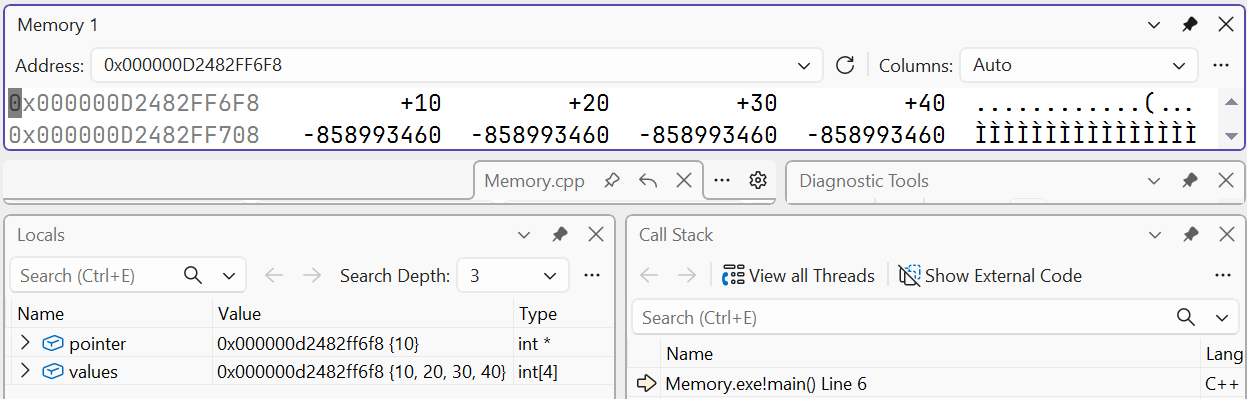
Figure 5.3. Viewing elements by address