
English
Strings and string_view
A string as a sequence of bytes
std::string from <string> owns a sequence of char. It supports concatenation +, appending +=, comparison and resizing. The size() member function counts code units, and for UTF-8 these are bytes, not letters and not visible characters. Therefore all exercises with character indexing in this topic use ASCII. Ukrainian strings can be stored and printed as a whole without character-by-character manipulation.
std::getline(std::cin, text) reads a line together with spaces up to the newline, which it discards. After a previous >>, the stream may still contain \n, and the first getline will return an empty string. You need to deliberately discard the rest of the previous line or read all data as lines. std::ws skips all leading whitespace, so it is not suitable if it is significant.
The find member function returns a position or std::string::npos. Do not compare the result only with zero: a match at position 0 is a success. substr(pos,count) creates a new string, while replace, insert, erase modify the existing one. After a modification, the positions of the remaining characters may shift. When searching for several matches, always define how the position will move, especially when the replacement again contains the searched text.
starts_with, ends_with and contains read as specific checks; the last one belongs to C++23. String comparison is lexicographic by code units, not by the rules of Ukrainian dictionary order. The string "10" precedes "2" lexicographically, although the number 10 is greater than 2.
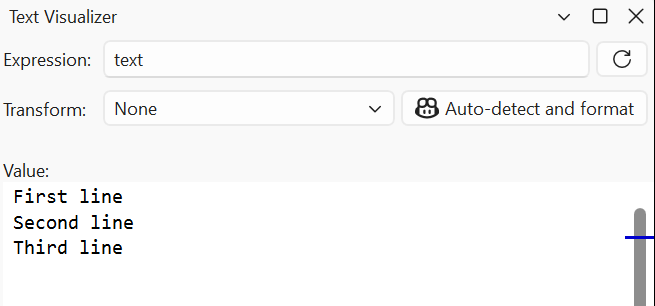
Figure 4.4. Viewing a long string
The <cctype> header has std::isdigit, std::toupper and other classifiers. Before passing an arbitrary char, it is converted to unsigned char; a negative value of a signed char is not a valid ordinary argument. These functions do not decode UTF-8. Converting each byte of a Cyrillic letter with toupper will not produce a correct Unicode uppercase letter.
Converting numbers and text
std::to_string creates a string from a number; for controlled formatting std::format from <format> is more useful. Unlike println, it returns the text and does not print it. std::stoi and std::stod read a number from a string, can throw exceptions and, without checking the position, allow an unused suffix. Therefore a successful parse does not yet prove that the whole string was a valid number.
std::from_chars from <charconv> returns a pair: a pointer to the first unprocessed character and an error code. For a complete number you need to check both ec == std::errc{} and ptr == end. Invalid syntax and an out-of-range value are different reasons for failure. The function does not skip leading whitespace and does not depend on the current locale; this is convenient for a machine format.
If the program expects an entered whole line, first read it, define the whitespace policy, then parse. Do not use atoi if you need to distinguish a genuine zero from a failed parse. Documentation: https://learn.microsoft.com/cpp/standard-library/charconv-functions.
string_view and lifetime
std::string_view from <string_view> is a non-owning view: it remembers the start and the length of already existing text. It does not copy the characters and does not extend the owner’s lifetime. This is convenient for a parameter of a reading function or for a part of a long unchanging string (Fig. 4.5).
Figure 4.5. Two views of a shared buffer
string_view view = std::string{"temporary"}; creates a dangling view after the statement ends: the temporary string is already destroyed. Similarly, reallocation of the buffer of the owning string can invalidate its old views. The safe principle: the owner lives longer than all views and does not change the buffer while they are in use.
view.substr returns another view, whereas string.substr returns a new owning string. You need to remember this difference when returning a result from a function. In addition, a view of a part of a string does not necessarily end with a null byte. Passing view.data() to an old C API that expects a null-terminated string without ensuring this condition is dangerous.
Example 4. ASCII text statistics
The program splits one line into words by spaces and tabs, counts them and finds the longest one. Punctuation remains part of the word. For equal lengths the first word is chosen.
cpp
#include <string>
#include <string_view>
#include <iostream>
#include <print>

int main()
{
    std::string line;
    if (!std::getline(std::cin, line)) return 1;
    for (unsigned char c : line)
        if (c > 127) return 1;
    const std::string_view text{line};
    std::string_view longest;
    std::size_t count{}, position{};
    while (position < text.size())
    {
        position = text.find_first_not_of(" \t", position);
        if (position == text.npos) break;
        auto end = text.find_first_of(" \t", position);
        if (end == text.npos) end = text.size();
        const auto word = text.substr(position, end - position);
        ++count;
        if (word.size() > longest.size()) longest = word;
        position = end;
    }
    std::println("words={}; longest={}", count, longest);
}
For one three two the answer is words=3; longest=three. For an empty line the count is 0 and the longest word is empty. The owner line exists until the end of main and does not change after the views are created, so the result is safe. If a function returned a view of its local string, the same idea would become an error.