
English
Operators as an interface
An operator as part of the interface
An overloaded operator is a function with a special name. The expression a + b for a class type can call a member function or a free function. This lets you write domain computations naturally: a sum of fractions, a product of matrices, a comparison of versions. However, a convenient syntax doesn’t justify unexpected semantics. Addition shouldn’t suddenly write a file.
You can’t create new operator symbols or change their precedence or arity. In particular, ::, ., .* and ?: can’t be overloaded. At least one operand of an ordinary overloaded operator must have a class or enumeration type. Your own class doesn’t give you the right to redefine what adding two built-in integers means.
A fraction needs an invariant first: the denominator is positive, the numerator and the denominator are reduced, and zero has a single representation. Without normalization, equality of the fields won’t match equality of the mathematical values. The zero-denominator check is done before division or reduction.
The example deliberately limits the input numerators and denominators to one million. This makes the intermediate products safe for long long; a result that doesn’t satisfy the constructor’s contract is rejected. Full arbitrary precision is a separate task, not a hidden property of a short class.
The construction is shown in Fig. 9.1.
Figure 9.1. An expression and its possible function forms
Example 1. A fraction
Problem. Reduce rational numbers, add them and compare them without floating point.
cpp
#include <cassert>
#include <compare>
#include <iostream>
#include <numeric>
#include <stdexcept>

class Fraction {
    long long n_, d_;
public:
    Fraction(long long n, long long d) : n_(n), d_(d) {
        if (n < -1'000'000 || n > 1'000'000 ||
            d < -1'000'000 || d > 1'000'000 || d == 0)
            throw std::invalid_argument("fraction range");
        if (d_ < 0) { n_ = -n_; d_ = -d_; }
        const auto g = std::gcd(n_, d_);
        n_ /= g; d_ /= g;
    }

    friend Fraction operator+(const Fraction& a,
                              const Fraction& b) {
        return {a.n_ * b.d_ + b.n_ * a.d_, a.d_ * b.d_};
    }
    bool operator==(const Fraction&) const = default;

    std::strong_ordering operator<=>(const Fraction& x) const {
        return n_ * x.d_ <=> x.n_ * d_;
    }

    friend std::ostream& operator<<(std::ostream& out,
                                    const Fraction& x) {
        return out << x.n_ << '/' << x.d_;
    }
};

int main() {
    Fraction a{1, 2}, b{1, 3};
    assert((a + b == Fraction{5, 6}));
    assert((Fraction{-2, -4} == a));
    assert((Fraction{0, 3} == Fraction{0, 1}));
    assert(a > b);
    try { Fraction bad{1, 0}; assert(false); }
    catch (const std::invalid_argument&) {}
    std::cout << a << " + " << b << " = " << a + b << '\n';
}
Normalized fields allow a defaulted equality. The user-defined spaceship operator compares the cross products, not the numerators alone. The outer parentheses in assert are needed where an initializer list contains a comma.
Output:
text
1/2 + 1/3 = 5/6
Figure 9.2. Going to an overloaded operator
Arithmetic, symmetry and compound operators
Usually operator+= modifies the left operand and returns a reference to it. operator+ can take the left operand by value, apply += to the copy and return the new value. This way one implementation defines the arithmetic meaning of both notations.
A member function has an implicit left operand, this. For symmetric multiplication money * count and count * money, two free functions are convenient: the second delegates to the first. Don’t make the constructor of an amount implicit just so that a number is accidentally converted into money in any expression.
Check for possible overflow before the arithmetic. In the money example, the limit / count check is done before the multiplication; a zero factor is handled without division by zero. += checks the remaining free range instead of computing an already overflowed sum.
Overloading << works with streams, but it doesn’t automatically make a type usable with std::println. The latter needs a specialization of std::formatter, which uses templates. In this topic, the current required interface is operator<<; we treat formatter as a further extension after the topic on templates, not as a hidden prerequisite.
The construction is shown in Fig. 9.3.
Figure 9.3. Going from a stronger order to a weaker one
Example 2. Money
Problem. Store a non-negative number of cents and make +=, + and symmetric multiplication by an integer count consistent.
cpp
#include <cassert>
#include <iostream>
#include <stdexcept>

class Money {
    long long cents_;
    static constexpr long long limit = 1'000'000'000;
public:
    explicit Money(long long n = 0) : cents_(n) {
        if (n < 0 || n > limit)
            throw std::invalid_argument("money");
    }

    Money& operator+=(Money b) {
        if (b.cents_ > limit - cents_)
            throw std::overflow_error("sum");
        cents_ += b.cents_; return *this;
    }

    friend Money operator+(Money a, Money b) { return a += b; }

    friend Money operator*(Money a, int n) {
        if (n < 0 || (n > 0 && a.cents_ > limit / n))
            throw std::invalid_argument("count");
        return Money{a.cents_ * n};
    }

    friend Money operator*(int n, Money a) { return a * n; }
    bool operator==(const Money&) const = default;

    friend std::ostream& operator<<(std::ostream& out, Money a) {
        return out << a.cents_ << " cents";
    }
};

int main() {
    Money a{1250};
    assert(a * 3 == 3 * a);
    assert(a * 0 == Money{});
    a += Money{50};
    assert(a == Money{1300});
    try { auto bad = a * -1; (void)bad; assert(false); }
    catch (const std::invalid_argument&) {}
    std::cout << a * 3 << '\n';
}
The cents are stored as integers, so the arithmetic doesn’t use approximate fractions. The output deliberately doesn’t change the format of someone else’s stream. Currency conversion isn’t part of this contract.
Output:
text
3900 cents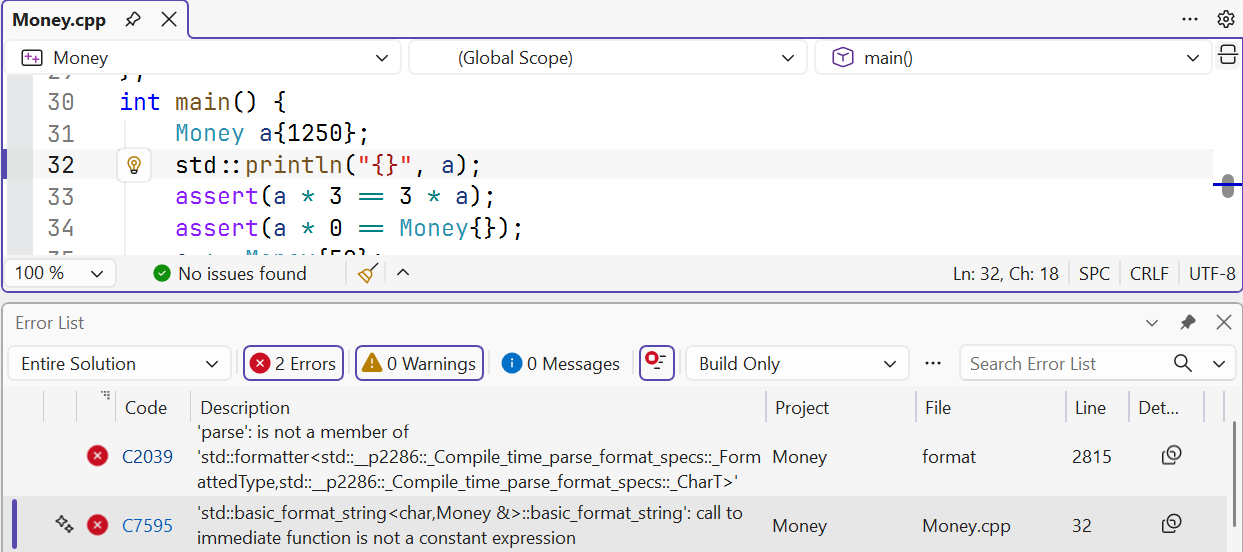
Figure 9.4. A missing formatter for a user-defined type