
English
assert and exceptions
assert, static_assert and context
assert(condition) from <cassert> checks an internal condition in configurations where NDEBUG is not defined. If the condition is false, the program terminates abnormally with a diagnostic. It is a tool for finding violations of invariants, not a replacement for validating user input. In Release, assert is often disabled.
Don’t write assert(++count > 0): the side effect will disappear together with the check. The operation must be separate, and the assertion should only observe the state. static_assert works at compile time and checks a constant expression; an index entered from the keyboard cannot be checked this way.
std::source_location from <source_location> lets you pass the file name, line and function to a log. A default argument with current() stores the call site, not just a single line inside the logging function. std::stacktrace from <stacktrace> in C++23 can provide the stack; the details of symbolization depend on the build and the available symbols. Addresses and text are not constant across all runs.
In the tested MSVC toolset, the C++26 header <debugging> is missing. That is why std::breakpoint is not used in the runnable examples. The presence of a similar IDE debugging feature doesn’t mean support for the standard library function.
An exception as a way to pass on a failure
An exception passes information about the impossibility of performing an operation to a suitable handler. throw value; creates a failure situation, try delimits the code, and catch describes the reaction. After throw, normal execution of the current function doesn’t continue from the next line.
While a handler is being searched for, stack unwinding is performed: fully constructed automatic objects of the abandoned scopes are destroyed. That is why RAII owners of memory, files and locks are important for correct cleanup (Fig. 6.5). A raw pointer won’t release a resource automatically just because a block is exited.
Figure 6.5. Exception propagation and destruction of local objects
Standard exceptions derive from std::exception. what() gives a diagnostic message. std::invalid_argument is appropriate for an invalid argument, std::out_of_range for going beyond the allowed range, and std::runtime_error for a failure at run time. The hierarchy lets you have specific and general handlers.
Figure 6.6. Part of the standard exception hierarchy
Catch by const std::exception& so as not to copy and not to slice the derived part of the object. Specific catch clauses go before general ones. catch (...) catches any C++ exception, but doesn’t provide its typed data. Don’t use an empty catch that silently pretends to succeed.
Example 2. Division with a check
cpp
#include <print>
#include <iostream>
#include <stdexcept>
#include <cmath>

double divide(double a, double b)
{
    if (!std::isfinite(a) || !std::isfinite(b))
        throw std::invalid_argument("Finite operands required");
    if (b == 0) throw std::invalid_argument("Zero divisor");
    const double result = a / b;
    if (!std::isfinite(result))
        throw std::overflow_error("Result is not finite");
    return result;
}

int main()
{
    try
    {
        double a{}, b{};
        if (!(std::cin >> a >> b))
            throw std::invalid_argument("Two numbers required");
        std::println("{:.3f}", divide(a, b));
    }
    catch (const std::invalid_argument& error)
    {
        std::cerr << "Input: " << error.what() << '\n';
        return 1;
    }
    catch (const std::exception& error)
    {
        std::cerr << "Failure: " << error.what() << '\n';
        return 2;
    }
}
The input 7 2 gives 3.500. 7 0 gives the message Input: Zero divisor and exit code 1. An overflow of the result goes to the general catch with code 2. The computation function doesn’t print the error itself: main makes the decision about the user interface.
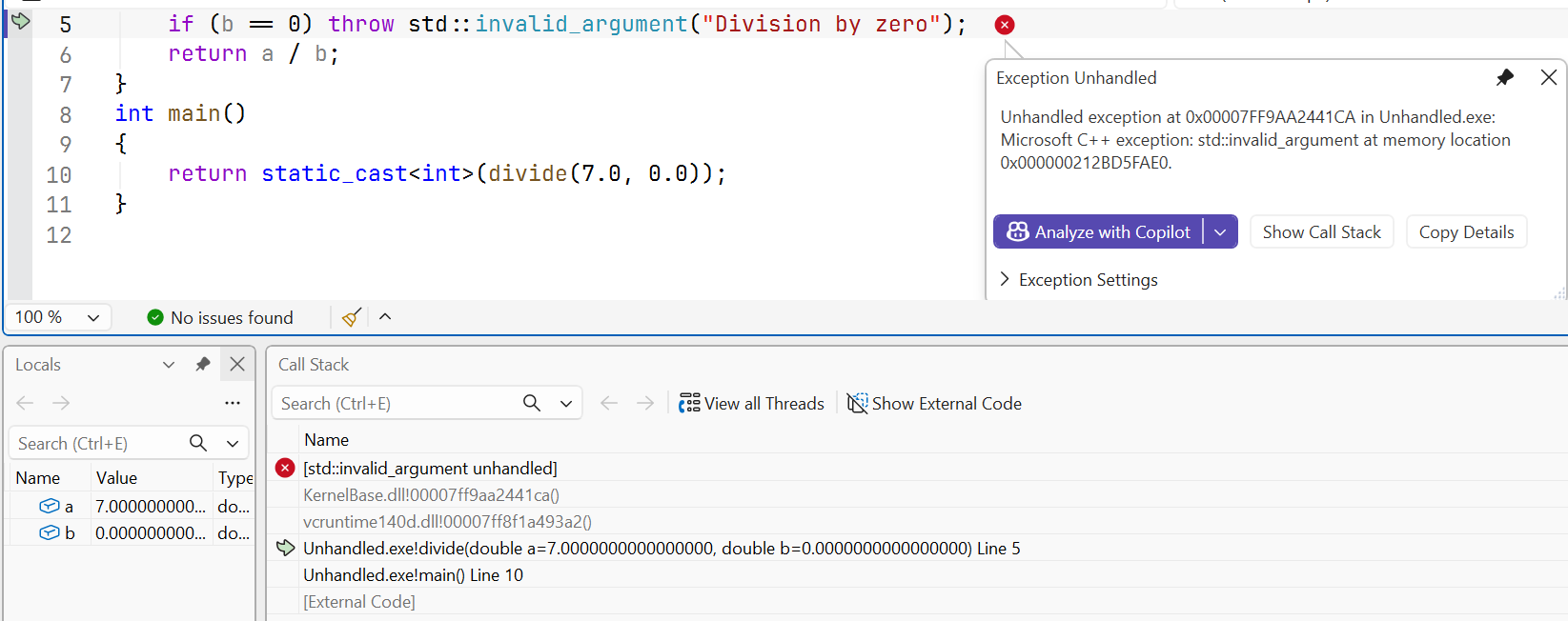
Figure 6.7. Stopping on an unhandled exception
Rethrowing with throw; inside a catch preserves the current exception. Writing throw error; may create a copy with the static type of the variable and lose the derived information. A handler that only adds context to the log can execute throw; for the higher level.
In Exception Settings you can break at the moment a C++ exception is thrown, even if it is caught later. This helps you see the initial state. The fact that the debugger stopped doesn’t yet mean that the program has no catch.

Figure 6.8. Break policy for C++ exceptions