
English
Composition and object lifetime
Composition and splitting code into files
Composition describes a “has-a” relationship. An order contains a customer and line items. When the line items are stored by value in a std::vector, the container itself manages their lifetime. Destroying the order destroys its data members automatically; you do not need to write a loop with delete.
The header Order.h contains the interface that a user of the type needs. Order.cpp contains the member function definitions; main.cpp uses the interface. Each .cpp file is compiled separately, and the linker combines the results. The command for this example is cl /std:c++latest /EHsc /W4 /utf-8 main.cpp Order.cpp. If you forget Order.cpp, the declaration is visible, but the definition will not be found at link time. This is a different stage from an error about accessing a private data member.
In this course, #pragma once protects a header from being included twice in the same translation unit; MSVC supports this directive. A header must itself include the standard headers its declarations need. Do not rely on an accidental order of #include directives in someone else’s file.
inline static defines a single data member shared by the whole class, not a copy per object. In the example, it counts calls to the constructor with parameters. It is neither a counter of live objects nor a source of uniqueness for copied orders: copying has its own rules, which we will study in the next topic.
The structure is shown in Fig. 7.5.
Figure 7.5. An order owns its customer and line items
Example 3. An order with a separate header
Problem. Compose an order from a customer and line items, compute the total, and count the originally created orders.
File Order.h:
cpp
#pragma once
#include <string>
#include <vector>

struct Customer { std::string name; };
struct OrderLine { int cents; int count; };

class Order {
    Customer customer_;
    std::vector<OrderLine> lines_;
    inline static int created_ = 0;
public:
    Order(Customer customer, std::vector<OrderLine> lines);
    int total() const;
    static int created() { return created_; }
};
File Order.cpp:
cpp
#include "Order.h"
#include <stdexcept>
#include <utility>

Order::Order(Customer customer, std::vector<OrderLine> lines)
    : customer_(std::move(customer)), lines_(std::move(lines)) {
    if (customer_.name.empty() || lines_.size() > 100)
        throw std::invalid_argument("order");
    for (const auto& line : lines_)
        if (line.cents < 0 || line.cents > 10'000 ||
            line.count < 1 || line.count > 100)
            throw std::invalid_argument("line");
    ++created_;
}

int Order::total() const {
    int sum = 0;
    for (const auto& line : lines_) sum += line.cents * line.count;
    return sum;
}
File main.cpp:
cpp
#include "Order.h"
#include <cassert>
#include <print>
#include <stdexcept>

int main() {
    const Order a{{"Olena"}, {{2500, 2}, {700, 3}}};
    assert(a.total() == 7100);
    const Order empty{{"Test"}, {}};
    assert(empty.total() == 0);
    try { Order bad{{""}, {}}; assert(false); }
    catch (const std::invalid_argument&) {}
    assert(Order::created() == 2);
    std::println("Total: {} cents; created: {}",
        a.total(), Order::created());
}
The limits on the number of line items, the price, and the quantity keep the total within the range of int. An empty order is allowed; an empty customer name is not. The counter increases only after the checks.
Output:
text
Total: 7100 cents; created: 2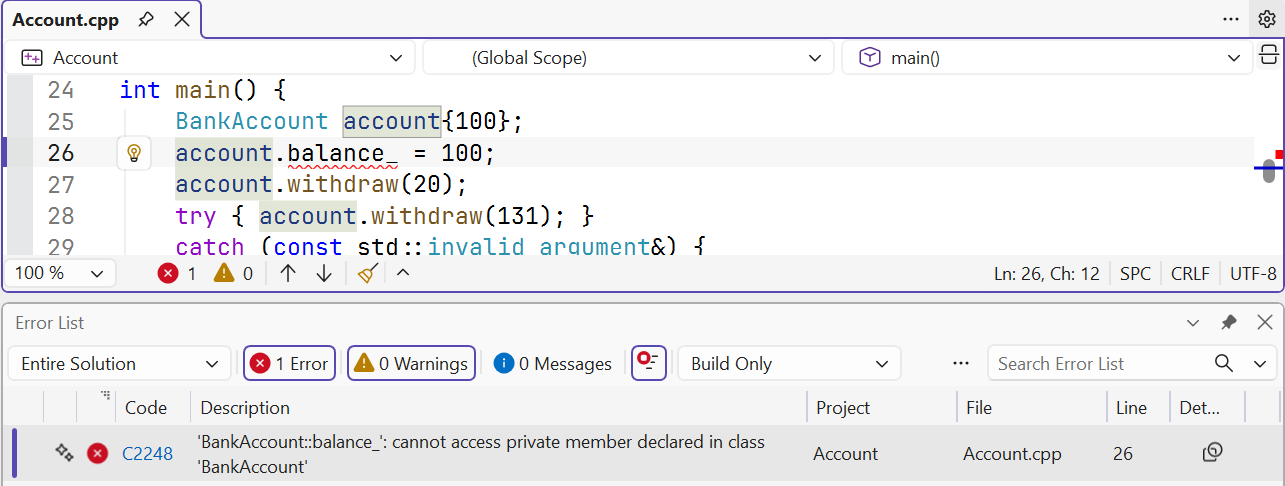
Figure 7.6. Protection of a private data member
Object lifetime and the destructor
A destructor ends an object’s lifetime. For a local object, it is called automatically when control leaves the scope, including when an exception causes the exit. For an object managed by unique_ptr, it is called when the owner releases the resource. It is the owner’s lifetime, not the word “heap,” that determines the moment of cleanup.
In a composite object, the data members are constructed first, and then the body of the outer class constructor runs. During destruction, the body of the outer class destructor runs first, and then the data members are destroyed in reverse order. That is why Car can use engine_ in its destructor, but once destruction has finished, the object must not be accessed.
If a constructor throws an exception, there is no complete outer object, so its destructor is not called. However, the data members that were already fully constructed are destroyed. This guarantee explains why composing classes from containers and smart pointers is better than managing resources by hand.
Printing messages in the destructor below is tracing for training purposes. An ordinary class with a string and a vector usually does not need a user-defined destructor. A destructor must not let an exception escape: a second exception during stack unwinding can terminate the program via std::terminate.
Example 4. Tracing object lifetime
Problem. Show the order of construction and destruction of a car with an engine in a nested scope.
cpp
#include <memory>
#include <print>

struct Engine {
    Engine() { std::println("Engine()"); }
    ~Engine() { std::println("~Engine()"); }
};

class Car {
    Engine engine_;
public:
    Car() { std::println("Car()"); }
    ~Car() { std::println("~Car()"); }
};

int main() {
    std::println("Start");
    {
        auto car = std::make_unique<Car>();
        std::println("Inside");
    }

    std::println("End");
}
The dynamic object belongs to a local unique_ptr. Leaving the scope destroys the owner, the car, and its engine. There is no manual delete.
Output:
text
Start
Engine()
Car()
Inside
~Car()
~Engine()
End