
English
Operations and console input
Operations and logical conditions
The arithmetic operations +, -, *, /, and % depend on types. 7 / 2 yields 3, while 7 / 2.0 yields 3.5. The remainder -7 % 3 is -1; Math.floorMod(-7, 3), which yields 2, is useful for normalizing a cyclic index.
The ++ and -- operators change a value. Their prefix and postfix forms differ in the expression's value. Do not combine several changes to the same variable in one complex expression: split it into steps. This makes checking easier and reduces reliance on memorized precedence rules.
A comparison produces a boolean. The chain 0 <= x <= 10 is not valid Java code; write x >= 0 && x <= 10. The && and || operators short-circuit: the second operand is evaluated only when needed.
java
int divisor = 0;
boolean valid = divisor != 0 && 100 / divisor > 2;
No division occurs in this fragment. Replacing && with & for boolean operands would force both parts to be evaluated. The bitwise operators &, |, ^, ~, <<, >>, and >>> on integers operate on bits, not conditions. >> preserves the sign; >>> fills the high-order bits with zeros.
The conditional operator condition ? a : b returns one of two values. It is useful for a short choice, but nested chains are often harder to read than an ordinary if. Do not confuse assignment = with equality testing ==.
Console input and locale
The main tool in this topic is Scanner. For numbers with a decimal point, set Locale.US so the contract does not depend on the Windows system language. Prose may use a Ukrainian decimal comma, but the machine input format must be unambiguous.
Scanner documentation: https://docs.oracle.com/en/java/javase/26/docs/api/java.base/java/util/Scanner.html. The described API was verified by running it on JDK 27.
By default, Scanner separates tokens with whitespace. hasNextInt checks the next token but does not consume an invalid one. Repeating the check without next leaves the loop stuck on the same text forever. EOF means the end of the stream, not an invalid number.
Example 1. Reliable count input
java
import java.util.Scanner;

public class ReadCount {
    public static void main(String[] args) {
        Scanner input = new Scanner(System.in, "UTF-8");
        while (true) {
            System.out.print("Count 1..100: ");
            if (!input.hasNext()) {
                System.out.println("End of input");
                return;
            }
            if (!input.hasNextInt()) {
                System.out.println("Not an integer: " + input.next());
                continue;
            }
            int count = input.nextInt();
            if (count < 1 || count > 100) {
                System.out.println("Out of range");
                continue;
            }
            System.out.println("Accepted: " + count);
            break;
        }
    }
}
For the tokens bad 0 12, the program rejects the text, then zero, then accepts 12. Each invalid token is consumed. For an empty stream, the program exits instead of repeating the prompt forever. In a simple CLI program, System.in belongs to the process; do not close it inside a helper method if other code still needs to read input afterward.
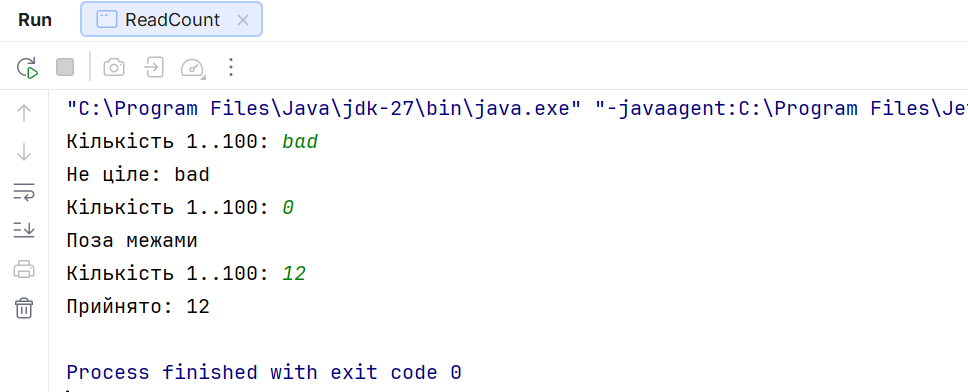
Figure 2.2. Rejecting invalid input in sequence
nextInt() leaves the delimiter after the token, while nextLine() reads the rest of the current line. After a number with no other text, that remainder is often empty. Choose a consistent strategy: tokens for all input, or lines followed by parsing.
Figure 2.3. A numeric token and the remainder of the line
java
import java.util.Scanner;

public class ReadProfile {
    public static void main(String[] args) {
        Scanner input = new Scanner(System.in, "UTF-8");
        if (!input.hasNextInt()) return;
        int age = input.nextInt();
        if (!input.hasNextLine()) return;
        input.nextLine();
        if (!input.hasNextLine()) return;
        String name = input.nextLine();
        System.out.println(name + ": " + age);
    }
}
For two lines, 20 and Olena Koval, the expected result is Olena Koval: 20. The extra nextLine() intentionally consumes the remainder of the first line. If the contract allows the name after the number on the same line, you need a different algorithm, not a mechanical copy of this one.