
English
Branching and pattern matching
Branching with if, elif, else
The condition after if is converted to a Boolean value. A colon begins a block, and indentation defines its boundaries. In an if/elif chain, only the first branch with a true condition runs. else runs if none of the preceding conditions matched (Fig. 2.4).
Figure 2.4. Checking if and elif conditions in sequence
Several independent if statements may execute several blocks. This is appropriate for independent properties: a number may be both positive and even. Mutually exclusive categories need a single chain. Order thresholds consistently: if you first check score >= 60, a later elif score >= 90 branch will never run for an excellent score.
The conditional expression a if condition else b returns a value: label = "even" if n % 2 == 0 else "odd". It is suitable for a short choice, but nested conditional expressions are hard to read. pass is an empty statement for a temporary block; it does not end a loop.
Example. A quadratic equation
Enter finite numeric coefficients a, b, and c. If a is zero, the equation is linear or degenerate. Otherwise, calculate the discriminant and real roots. Entering text instead of a number is not handled here.
py
import math

a = float(input("a: "))
b = float(input("b: "))
c = float(input("c: "))
if not (math.isfinite(a) and math.isfinite(b)
        and math.isfinite(c)):
    print("Coefficients must be finite")
elif a == 0:
    if b != 0:
        print(f"Linear: x = {-c / b:.3f}")
    elif c == 0:
        print("Infinitely many solutions")
    else:
        print("No solutions")
else:
    d = b * b - 4 * a * c
    if not math.isfinite(d):
        print("Coefficients are too large")
    elif d < 0:
        print("No real roots")
    elif d == 0:
        print(f"x = {-b / (2 * a):.3f}")
    else:
        root = math.sqrt(d)
        print(f"x1 = {(-b - root) / (2 * a):.3f}")
        print(f"x2 = {(-b + root) / (2 * a):.3f}")
For input 1, -3, 2, the program prints x1 = 1.000 and x2 = 2.000. Separately test 1, 2, 1, 1, 0, 1, 0, 2, -4, 0, 0, 0, and 0, 0, 1. These data sets cover different branches.
Comparing an entered coefficient exactly to zero is a deliberate choice here. For arbitrary measured coefficients, a discriminant near zero requires a justified tolerance. The direct formula may also lose precision when subtracting close numbers. This is a learning algorithm for moderate coefficients, rather than a universal numerical solver.
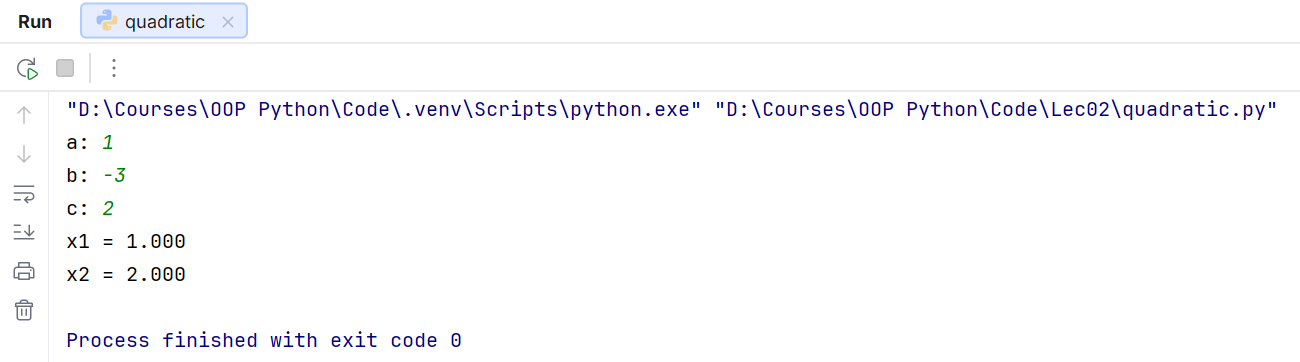
Figure 2.5. Entering coefficients and viewing roots in the Run window
Structural pattern matching with match
match evaluates a value and checks case patterns from top to bottom. The first matching block runs. There is no automatic fall-through to the next block, so break is not needed between branches. A vertical bar | combines alternative patterns; _ matches any value without storing it in a variable.
A bare name in a pattern is a capture (capture), rather than a comparison with a previously created variable. Thus, case command: accepts any value. A text command needs quotes: case "sum":. A guard after if is checked after the pattern matches. If it is false, matching continues. Introduction: https://peps.python.org/pep-0636/.
Example. A calculator menu
The commands +, add, /, and div specify an operation; 0 or exit ends the program. Operands are entered on separate lines in numeric format. The user should know this contract before starting the loop.
py
import math

while True:
    command = input("Operation (+, /, 0): ").strip()
    if command == "0" or command == "exit":
        break
    if command not in ("+", "add", "/", "div"):
        print("Unknown command")
        continue
    a = float(input("a: "))
    b = float(input("b: "))
    if not (math.isfinite(a) and math.isfinite(b)):
        print("Finite numbers are required")
        continue
    match command:
        case "+" | "add":
            print(f"Result: {a + b:.2f}")
        case "/" | "div" if b != 0:
            print(f"Result: {a / b:.2f}")
        case _:
            print("Division by zero is not allowed")
A session with command add, numbers 2 and 3, and then command 0 includes Result: 5.00. The div command with 2 and 0 produces a division-by-zero message and returns to the menu. The tuple in the not in check is used here only as a compact list of commands; collections will be studied in detail later.