
English
Relationships and joins
Relationships and joins
One author can have many books, and a book can have many historical loans. Instead of repeating the author's name in every book, a foreign key is stored. This reduces inconsistencies when renaming. ON DELETE must reflect the domain rule: delete the dependent data, forbid the deletion, or clear a nullable reference.
Figure 14.5. Relationships in the educational library
innerJoin keeps only rows that have a match on both sides. leftJoin keeps all rows of the left table; the fields of a missing right row will be NULL. So the report "all authors, even those without books" needs an outer join. Place a condition on the right table carefully so that WHERE does not discard the NULL rows.
Example 2. A catalog and the number of books
We create two authors and three books. The first query prints the title and the author; the second, the number of books per author. Both queries have an explicit order. For convenience, each ResultRow is read immediately within the transaction.
kotlin
import java.nio.file.Files
import org.jetbrains.exposed.v1.core.*
import org.jetbrains.exposed.v1.jdbc.*
import org.jetbrains.exposed.v1.jdbc.transactions.transaction

object Authors : Table("authors") {
    val id = integer("id").autoIncrement()
    val name = varchar("name", 100)
    override val primaryKey = PrimaryKey(id)
}

object Books : Table("books") {
    val id = integer("id").autoIncrement()
    val title = varchar("title", 120)
    val author = integer("author_id").references(Authors.id)
    override val primaryKey = PrimaryKey(id)
}

fun main() {
    val path = Files.createTempFile("library-", ".db")
    val db = Database.connect(
        "jdbc:sqlite:$path?foreign_keys=on", "org.sqlite.JDBC"
    )
    transaction(db) {
        SchemaUtils.create(Authors, Books)
        val a = Authors.insert { it[name] = "Author A" }[Authors.id]
        val b = Authors.insert { it[name] = "Author B" }[Authors.id]
        for ((title, author) in listOf(
            "Spring" to a, "Summer" to a, "Autumn" to b
        )) {
            Books.insert {
                it[Books.title] = title
                it[Books.author] = author
            }
        }
        (Books innerJoin Authors)
            .select(Books.title, Authors.name)
            .orderBy(Books.id)
            .forEach {
                println("${it[Books.title]}: ${it[Authors.name]}")
            }
        val count = Books.id.count()
        (Authors innerJoin Books)
            .select(Authors.name, count)
            .groupBy(Authors.id, Authors.name)
            .orderBy(Authors.id)
            .forEach { println("${it[Authors.name]}: ${it[count]}") }
    }
    path.toFile().deleteOnExit()
}
text
Spring: Author A
Summer: Author A
Autumn: Author B
Author A: 2
Author B: 1
The count aggregate is an SQL expression object; it is stored in a variable and used to read the same column of the result. sum and avg can return NULL for an empty group. Converting NULL to zero must be an explicit domain decision.
If a table is joined twice, for example the sender and the recipient of a transfer, you need alias aliases. Without them, identical columns cannot be distinguished. For large reports, check the query plan and indexes instead of loading all rows for a Kotlin groupBy.
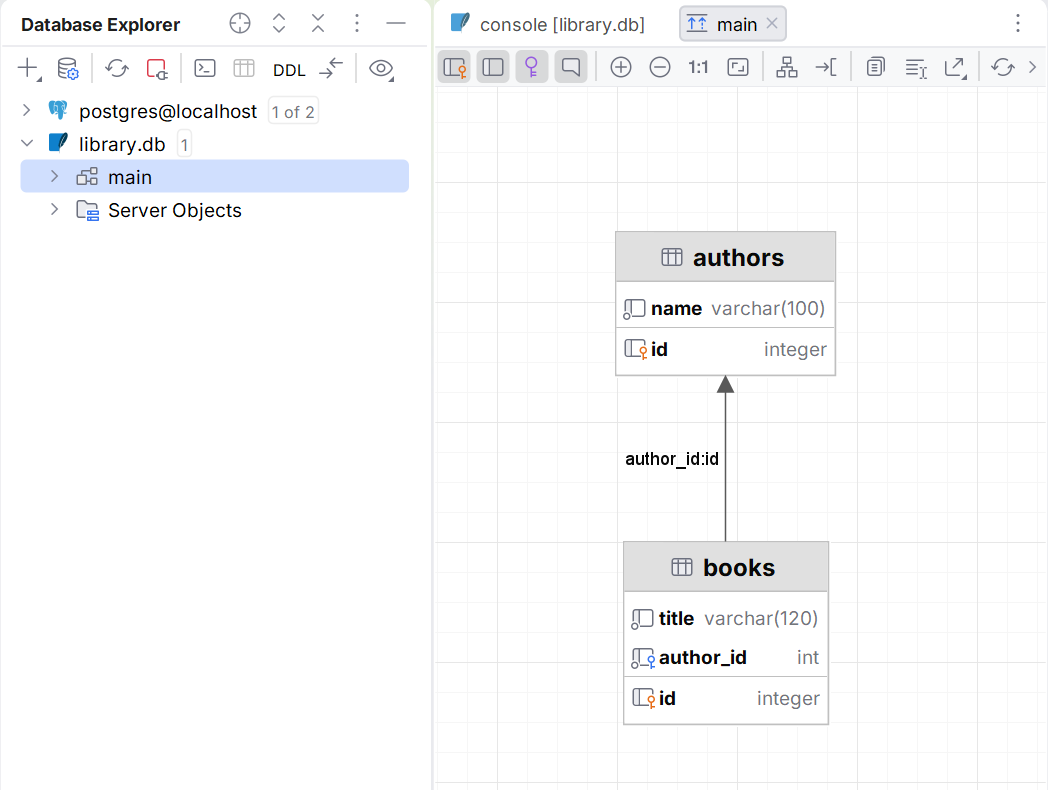
Figure 14.6. Tables and foreign keys in a database client