
English
Exceptions and try–catch
Errors and their observable behavior
A program may be syntactically correct and still fail to meet its requirements. The compiler finds compilation errors, exceptions occur at runtime, and a logic error may produce an entirely ordinary number. Thus, exception handling does not replace checking formulas.
An exception is an object that describes abnormal completion of an operation. After throw, normal execution of the current block is interrupted. The runtime looks for a matching handler in the current call and then higher up the stack. If no such handler exists, the unfinished path reaches the program boundary and usually terminates the program.
A user error must not corrupt data state. For example, an invalid transfer amount must be rejected before funds are withdrawn. A “something went wrong” message does not help if the balance is already incorrect afterward. An error contract describes both the message and the state after the error.
Official explanation: https://kotlinlang.org/docs/exceptions.html. This topic uses stable Kotlin 2.4 constructs; experimental alternatives to the error model are not prerequisites for completing the lab.
The Throwable hierarchy on the JVM
The base type is Throwable. The Exception branch contains errors that applications can often handle, while Error contains serious environment or runtime problems, such as insufficient memory. An ordinary input form should not catch all Throwable instances and continue as if program state were reliable.
Figure 4.1. Simplified JVM exception hierarchy
NumberFormatException is a subtype of IllegalArgumentException. Therefore, place a narrow handler before a broad one. ArithmeticException is used, among other things, for integer division by zero; floating-point division has different semantics and may produce infinity or NaN.
Kotlin does not require checked exceptions to be declared in a function signature. This differs from Java, but it does not mean a function cannot throw an exception. @Throws is sometimes used for Java callers; the annotation does not turn Kotlin code behavior into automatic checking of every error.
The same failed operation can mean different things at different levels. In a parsing function, it is a “nonnumeric string”; in a form, an “invalid quantity field”; in a CLI, a nonzero exit code. Transforming an error should add context, not destroy its original cause.
try, catch, and finally
try surrounds an operation expected to throw an exception. catch specifies the type that can be handled at that location. finally performs cleanup during normal exit or stack unwinding. It is not a guarantee against a process crash or power loss.
Figure 4.2. Handler selection and cleanup actions
Do not place all of main inside one large try if you only need to handle one expected failure. A narrow boundary makes it clear which operation caused the message. An empty catch hides the cause and makes subsequent results unreliable.
Example 1. Safe integer division
kotlin
fun main() {
    try {
        print("Dividend: ")
        val a = readlnOrNull()?.toInt()
            ?: throw IllegalArgumentException("Missing dividend")
        print("Divisor: ")
        val b = readlnOrNull()?.toInt()
            ?: throw IllegalArgumentException("Missing divisor")
        require(a in -1000000..1000000)
        require(b in -1000000..1000000)
        println("Quotient: ${a / b}")
        println("Remainder: ${a % b}")
    } catch (error: NumberFormatException) {
        println("An integer is required")
    } catch (error: ArithmeticException) {
        println("Division by zero")
    } catch (error: IllegalArgumentException) {
        println("Invalid input: ${error.message}")
    } finally {
        println("Attempt completed")
    }
}
For 17 and 5, the result is quotient 3, remainder 2, followed by Attempt completed. For 17 and 0, there is no quotient message: control passes to the matching catch and then to finally. For the string abc, the number format handler runs.
The imposed numeric bounds also eliminate the special overflow case Int.MIN_VALUE / -1. Do not expect all integer arithmetic overflow to automatically throw an exception. Topic 2 already showed how a product can silently go out of range.
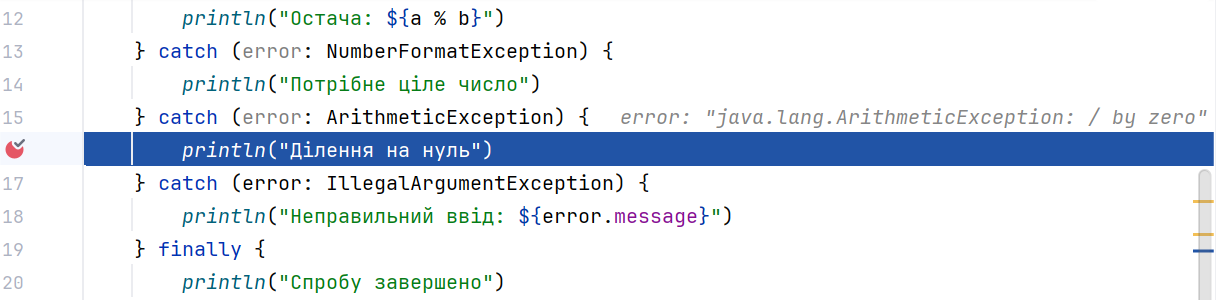
Figure 4.3. Control passing to the division-by-zero handler